Tuesday, 13 November 2012

France by bike and by van

We've been keeping busy, in between sessions of lying low through wet autumn weather (November being statistically the rainiest month here). When the weather's fair, we get out on the bike and are gradually extending our range as the cycling fitness levels improve.
Our latest run took us up to about 45 miles round trip to the mouth of the Gironde, at Royan.

Autumn leaves in Les Arces 
Royan was badly flattened in the later stages of the Second World War and extensively rebuilt through the 1950s, including the main church, Notre Dame de Royan, which was constructed to a radically new design, begun in 1955 and finished in 1958. The building looks a bit odd from the outside, but the space within is quite remarkably arresting and can accommodate around 2000 people.

The concrete Notre Dame de Royan
Plain without, stunning within 
Digging the beach at Royan
Crazy mud berths at Les Monards
A surprise jaunt to Belgium cropped up when we were given a commission to pick up a big (BIG) van-load of stuff near Brussels and bring it back to Mortagne. We had to make the journey up in one 10-hour go, which was fairly tough, with the crossing of Paris falling smack in rush hour, but once the van was loaded up we were free to do a bit of touring on the way back down and stopped several nights.

Belgian interlude: the park at Tervuren
Gent: Who says Belgium is boring?
Arras town hall, almost entirely rebuilt after WWI
The inner basin at Honfleur, Normandy
Honfleur street
Armistice Day in Normandy
War grave at Pont l'Eveque
The Chateau at Bazouges, Loir Valley
Look back in Angers, at the 12th century cathedral
13th century stained glass windows, Angers Cathedral
Pleasant as the trip was, we were pretty tired by the time we got back and still agree that touring by boat is the best!

Feline sleepover, back on board

Thursday, 1 November 2012

Rambling about the Charente-Maritime

The white chaton, currently under our cat-sitting care
The rain did let up eventually and we've had some beautiful autumn weather to go exploring and to get the vessel snugged down for winter. All the sails are washed, dried and put away, ditto all the lines. Inside the heater is seeing daily use now, but luckily the colder weather has knocked down the mosquitoes. The other good thing about the cool weather is that we have refrigeration again (i.e. the forward cabin, which we now keep closed off from the cosy saloon) and can buy and store cheese and keep the beer at a more palatable temperature. Condensation is the one fly in the ointment, but leaving the hatch wide open overnight keeps it to a minimum.

Poitou donkeys, the local breed
Cycling along the riverside plains, we find a mini ecosystem in its small drainage channels: kingfishers, crayfish and even muskrats! The muskrats are not native so we were very surprised to see several of them merrily swimming along. The birdwatching is very good among the marshes and reed beds of the estuary, hundreds of herons, waders and warblers.

Wish this cafe were still in business, at the original prices
We've upped the ante on our cycling tours, doubling our distance from 30 km to 60 km on a tour to the pretty mediaeval town of Pons, which happens to be on the Chemin St Jacques (French for the Camino de Santiago de Compostela) so we are still on the pilgrim route.

The Donjon in Pons (it rhymes in French)
The pilgrims' hospice, Pons
The small country roads are ideal cycling terrain, but the sign-posting is a bit haphazard and we've had a few involuntary detours. The countryside is very pleasant, mainly arable, dominated by vineyards and dotted with cute villages and hamlets centred around picturesque churches.

Detail of the church in St Germain du Seudre
The French (the rural ones, at least) seem to be preserving more of an unhurried pace of life and who can blame them? Shops still have rather limited opening hours, for example, and tradesmen seem to take a lot longer than in northern Europe. The flour mill had to wait seven months for seven of its windows to be double-glazed and reinstalled. But then if they can maintain this lifestyle in the face of global competition, maybe they're on to something.

Right now the wind is howling through the harbour with gusts of up to 45 knots, but we are nice and snug in our sheltered berth. Tomorrow, winds of 35 knots, gusting 50, are forecast. Looks like another restful day in store.


Monday, 22 October 2012

Hou la la, what rain

Uncharacteristically (we've repeatedly been told) it has been raining pretty much non-stop for the past week or 10 days. These depressions normally pass either further north or south - don't they know that? On a couple of days the rain was so hard that we barely made it off the boat at all. Luckily, Jim had rigged up our tarpaulin vestibule just in time so we had some outside space for leaving wet footwear and jackets and for doing the dishes.

Our tarp vestibule, which can be fully closed with an open brolly
I had questioned the need for taking wellington boots along, but boy are they handy! Another essential on board is the mosquito net. The wet weather brought another outbreak of desperately hungry mosquitoes. Between them, our mosquito coils and the net draped over our bunk deal with those that manage to escape being killed with our bare hands.

Mosquito-proof sleeping arrangements
To keep ourselves entertained, we started a batch of sloe gin with sloes picked from local hedgerows and aguardiente given to us in Pontevedra. This will mature over the winter and be ready for consumption in early spring. The foraging around here has been good. Unfortunately, the fig season is over now, but there are still walnuts and chestnuts.

Sloes, aguardiente and sugar, that's all there is to it
And, of course, the bad weather has been the ideal opportunity to get knitting again. At this rate, I'll be able to knit us a whole new winter wardrobe...

New hats

Thursday, 11 October 2012

French country living

Time for the squash harvest


Sadly, the grape harvest is mainly done by machine these days
We are back on board in Mortagne after being away from the boat for more than a night for the first time in 16 months. But it was all for a good cause - to celebrate my father's 70th birthday, in Provence. Now we plan to stay here until early spring before continuing north. We have started to settle in and meet people, including the lovely Hamard family, who are just back from sailing around the world via Antarctica and Newfoundland with four kids (some great pics here). Jim's even managed to pick up some work in an old flour mill that is being converted into flats. We've also bought ourselves a tandem to extend our land range - public transport is not really an option around here.

Our new transport mode
Our first tour was to the nearest big supermarket, 15 km away in Gemozac, and the land was not as flat as it seemed in our friends' auto! We got a good workout on the gentle rolling hills and will have to train up a little before venturing to Cognac (50 km), Rochefort (60 km) or even La Rochelle (90 km). However, already our second tour to the pretty medieval village of Talmont-sur-Gironde involved a lot less muscle pain. Cycling on a tandem is much like sailing on a pretty boat - it generates a lot of goodwill and smiles from people.

Cycling along the Cote de la Beauté
Medieval Talmont sur Gironde
Along the ramparts of Talmont
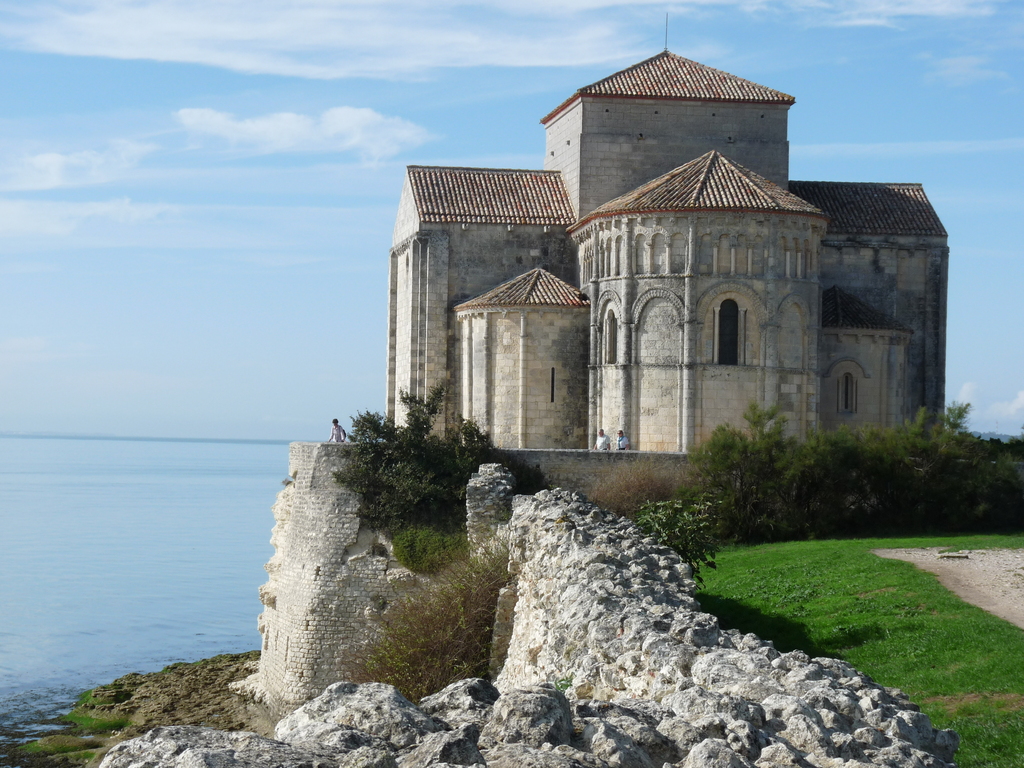
Eglise Sainte Radegone, Talmont
Jim's new workplace, the old flour mill in Mortagne
Compared with Spain, living costs are higher here - we can't really go to cafes for a daily coffee any more, never mind a weekly meal out. However, the local produce, wine, bread and pastries are very good and cheap and there are also other compensations: It's incredibly calm and peaceful, cats are very amenable to being stroked (in Spain you could hardly get near a cat and here we already have several feline friends, including three chatons) and we can communicate a bit better, with the school French slowly returning.

The weather is still good with temperatures around 18-20C, albeit with occasional rain, but we've already borrowed a fan heater for when it gets colder. There is a major weather divide at the River Loire and we hope that by staying south of it we'll escape the worst of the winter weather. 

Saturday, 15 September 2012

Courant violent

Port de Mortagne-sur-Gironde, winter quarters

We only stopped the one night at Meschers, neither the silent atmosphere of closed-up holiday homes nor the price per night encouraging us to stick around. The moment the automatic lock gate opened, two and a half hours before high water, we were on our way so as to catch the last of the flood up to Mortagne. The pilot book indicates that the lock at Mortagne is only opened from HW-1 to HW, so we didn't want to miss our chance. As it turns out, that was a bit of an exaggeration. Depending on the size of the tide, it's open from two to four hours.

Following the narrow channel in through the surrounding reed beds, we were immediately impressed by the security of shelter inside, the pretty setting with the limestone cliffs behind and the relaxed friendliness of the harbour master and other local folk. Here, we thought, is a potential wintering spot. The clincher came when we found out the price - very, very reasonable. In fact, the cheapest marina we've encountered on the trip so far.

The view from our cockpit
Vineyards adorn the higher ground 
They grow other stuff too. Sunflowers ready for harvest
We did still want to have a shot at visiting Bordeaux before the rumoured shutdown of its lock for winter maintenance so, after a couple of nights at Mortagne, we set off up river. We hurried up on the tail end of the flood, reaching Blaye just at the turn of the tide. Unfortunately, a stiff breeze was blowing against the increasing ebb flow, raising an ugly brown chop that made the prospect of lying on the 'halte nautique' unappealing in the extreme. The 'Courant Violent' sign on the bridge leading out to the pontoon wasn't kidding. We heard later that more than one boat has sunk at this pontoon in rough conditions!

Blaye's halte nautique - it's right out there
Blaye shenannigans
The pink line shows our peregrinations at Blaye. We took one look at the pontoon and said, 'Nah!', thought we might get a reasonable anchorage over by the Ile Nouvelle, where we'd noticed some moorings on the way past. Went over for a look and said, 'Nah', went over to the Ile de Pate, anchored, rolled around for a bit and said, 'Nah', hauled up the anchor (of course the current was increasing all this while) and went back to the Ile Nouvelle, where we passed, if not a comfortable, at least a tolerable night. The current was pretty considerable, perhaps 3.5kt and this 5 days before spring tide. I dreamt of the anchor chain snapping, but of course everything was all right and the anchor well and truly buried in the thick river mud.

The wind too carried on howling most of the night but conditions were slightly calmer in the morning as we waited for slack water before moving across to the pontoon. The tides, not surprisingly, are a bit odd up this large river estuary. The main difference from what we're used to is that the ebb continues to run for about an hour and a half after the time of predicted low water. Slack tide is then very brief and the current picks up swiftly into the flood.

Anyhoo, we sat and waited for the tide to turn, then hauled the anchor and crossed back to the pontoon. The flood was already running at maybe 1kt as we made a lovely docking on what we subsequently discovered to be the commercial (wrong) side of the pontoon. Leisure craft are meant to go on the inside, which is actually slightly more sheltered, so we decided to shift around though the current was running stronger all the time. It was kind of a fun challenge and we brought it off without mishap or shouting, though no doubt things would have been different if anybody else had been watching.

Blaye's main (only?) attraction, but it's a good one 
Picturesque ruins inside Blaye Citadel
Blaye's other undoubted attraction
With the raging current and ugly chop, the halte nautique really wasn't a comfortable or restful berth. Problems with the lifting bridge and lock at Bordeaux and the fact that our friends there would be away in any case, plus the approaching spring tide and equinox (with its likely attendant gales) decided us to beat a strategic retreat back to the haven of Mortagne. We left before dawn the next morning, when all was calm and beautiful and we had the whole of the ebb to boost us along.

Just a sliver of moon to keep us company in the pre-dawn chill
Misty morning on the Gironde
A river of many moods


Sunday, 9 September 2012

A short hop across Biscay

The world's oldest transporter bridge, Getxo near Bilbao
Still transporting, after all these years
Industrial Astillero turned out to be the highlight of the Santander estuary as far as we were concerned. It was a pleasant, friendly, working town, with a superbly sheltered anchorage and easy landing for the dinghy. The rest was either bland (Santander itself) or simply holiday/beach towns (Somo).

We left Astillero reluctantly to be near the exit for departure when the weather suited and passed one more rolly night at the Santander anchorage before tucking into a tight but well sheltered spot behind a giant sandy spit. We thought we might spend a few days there, but the tides were large and the spot was so tight we ended up briefly aground at low water. Not really a problem in itself, but we were very near a steep ledge and I was slightly concerned lest the rudder end up on the ledge on the next tide and be damaged.

So, it was snap decision time again and we had an excellent, really excellent, sail to Bilbao. We looked in at Castro Urdiales on the way, as folk had recommended it and it's meant to have an interesting Templar castle, but it was very lumpy outside and we could see the masts of the boats inside waving wildly around, so we pressed on. 40+ miles in 7 hours on a lunchtime departure is a good day!

Biscay turns out to be a real sunfish hotspot. We've seen them on pretty much every passage since Ribadeo and even spotted them leaping right out of the water. They don't look like a jumping sort of fish, so we don't understand how they manage it.

Guggenheim: nice building, pity about the entry price
Bilbao's Santander station
Bilbao is an obviously wealthy, rather grandly elegant city. We had a couple of days in town and took in some culture, eschewing the absurdly pricey Guggenheim in favour of the free (on Wednesdays) Fine Arts Museum, where there was an excellent Goya exhibition on.

The anchorage, indeed the harbour, of Bilbao is miles away from the city, but the superb metro system makes it very easy to get around. The suburbs surrounding the harbour are also quite wealthy (only place we've ever seen moving pedestrian walkways outside about town) and pleasant. They boast the world's oldest transporter bridge, which is the only way across the river for miles around and only €0.35 for pedestrians.

Bilbao, we decided, would be our last stop in Spain as the difficulty of getting a sailing breeze for Bordeaux only increases as the inside corner is reached and the distance to sail doesn't diminish further. It's challenging nevertheless, since westerly winds are generally accompanied by big seas that make the entrance to the Gironde impossible. Ideally, we wanted wind straight northerly, easterly or south of east but what prevails, and what we got, was northeasterly.

We made an evening departure, hoping for a two-night one-day passage, reaching the Gironde early on the second day. Contrary winds stretched the passage out to a full two days, but quite enjoyable.

It was lumpy for the first day, but the weather was fair and the nights warm and starry. It was good to be offshore again, for the first time since reaching Bayona 4 months ago. Quite a few sailors we've met in these parts have remarked on the absence of dolphins, but we've found that it's only the case in coastal waters. They, and not incidentally the fishing fleet, concentrate around the continental shelf.

An uncharacteristically quiescent Biscay
Still still at sunset
France ho! Landfall at Gironde. Not much land evident.
The wind abandoned us on the last day with about 30 NM still to go so we had to stop for a swim and then chugged along in the brilliant sunshine, coming to anchor in the Gironde a couple of hours after sunset. The plan then was to get up stupidly early the next day (today) to catch the tide up to Paulliac, halfway to Bordeaux, but when we did get up at 0530 it was to find everything draped in superthick, wet fog. We weren't really sorry to get back into bed and snooze a few hours longer.

When the fog finally lifted, there was only two hours remaining on the flood, so we shaped our course for the small port of Meschers, accessible to vessels up to 9 m at high water +/-2.5 hours.

The caves of Regulus, at Meschers
Shrimping huts
We're not far from Spain at all, geographically, but the character of the country, the people, the architecture is totally, strikingly different. Got to love that.

Mais oui! C'est la France, dahling!