Sunday, 9 September 2012

A short hop across Biscay

The world's oldest transporter bridge, Getxo near Bilbao
Still transporting, after all these years
Industrial Astillero turned out to be the highlight of the Santander estuary as far as we were concerned. It was a pleasant, friendly, working town, with a superbly sheltered anchorage and easy landing for the dinghy. The rest was either bland (Santander itself) or simply holiday/beach towns (Somo).

We left Astillero reluctantly to be near the exit for departure when the weather suited and passed one more rolly night at the Santander anchorage before tucking into a tight but well sheltered spot behind a giant sandy spit. We thought we might spend a few days there, but the tides were large and the spot was so tight we ended up briefly aground at low water. Not really a problem in itself, but we were very near a steep ledge and I was slightly concerned lest the rudder end up on the ledge on the next tide and be damaged.

So, it was snap decision time again and we had an excellent, really excellent, sail to Bilbao. We looked in at Castro Urdiales on the way, as folk had recommended it and it's meant to have an interesting Templar castle, but it was very lumpy outside and we could see the masts of the boats inside waving wildly around, so we pressed on. 40+ miles in 7 hours on a lunchtime departure is a good day!

Biscay turns out to be a real sunfish hotspot. We've seen them on pretty much every passage since Ribadeo and even spotted them leaping right out of the water. They don't look like a jumping sort of fish, so we don't understand how they manage it.

Guggenheim: nice building, pity about the entry price
Bilbao's Santander station
Bilbao is an obviously wealthy, rather grandly elegant city. We had a couple of days in town and took in some culture, eschewing the absurdly pricey Guggenheim in favour of the free (on Wednesdays) Fine Arts Museum, where there was an excellent Goya exhibition on.

The anchorage, indeed the harbour, of Bilbao is miles away from the city, but the superb metro system makes it very easy to get around. The suburbs surrounding the harbour are also quite wealthy (only place we've ever seen moving pedestrian walkways outside about town) and pleasant. They boast the world's oldest transporter bridge, which is the only way across the river for miles around and only €0.35 for pedestrians.

Bilbao, we decided, would be our last stop in Spain as the difficulty of getting a sailing breeze for Bordeaux only increases as the inside corner is reached and the distance to sail doesn't diminish further. It's challenging nevertheless, since westerly winds are generally accompanied by big seas that make the entrance to the Gironde impossible. Ideally, we wanted wind straight northerly, easterly or south of east but what prevails, and what we got, was northeasterly.

We made an evening departure, hoping for a two-night one-day passage, reaching the Gironde early on the second day. Contrary winds stretched the passage out to a full two days, but quite enjoyable.

It was lumpy for the first day, but the weather was fair and the nights warm and starry. It was good to be offshore again, for the first time since reaching Bayona 4 months ago. Quite a few sailors we've met in these parts have remarked on the absence of dolphins, but we've found that it's only the case in coastal waters. They, and not incidentally the fishing fleet, concentrate around the continental shelf.

An uncharacteristically quiescent Biscay
Still still at sunset
France ho! Landfall at Gironde. Not much land evident.
The wind abandoned us on the last day with about 30 NM still to go so we had to stop for a swim and then chugged along in the brilliant sunshine, coming to anchor in the Gironde a couple of hours after sunset. The plan then was to get up stupidly early the next day (today) to catch the tide up to Paulliac, halfway to Bordeaux, but when we did get up at 0530 it was to find everything draped in superthick, wet fog. We weren't really sorry to get back into bed and snooze a few hours longer.

When the fog finally lifted, there was only two hours remaining on the flood, so we shaped our course for the small port of Meschers, accessible to vessels up to 9 m at high water +/-2.5 hours.

The caves of Regulus, at Meschers
Shrimping huts
We're not far from Spain at all, geographically, but the character of the country, the people, the architecture is totally, strikingly different. Got to love that.

Mais oui! C'est la France, dahling!


Monday, 27 August 2012

Birds of a Feather

One of the N Atlantic's stranger fish, the Sunfish, in Ribadesella

There's probably no need to point out that the forecast didn't hold true, so we didn't make the Bordeaux run. In general, the forecasts have been highly unreliable along this stretch of coast, possibly owing to the presence of the Picos de Europa just inland. A couple of days after our previous post, we picked up a fresh grib file, hoping to find conditions still fair for the Gironde. The wind direction was still ok, but the strength was up a bit - to gale force for a time - but the main problem was the sea state. Swell up to 3.5m, which might not be fun on the infamous inner Biscay coast.

Great hedge, lousy tasting maracuja
Ribadesella: nice beach and snug harbour
The swell would also make egress from Ribadesella impossible, so we decided to make a dash for Santander, 60 NM along the coast. The screenshot below shows what the forecast, from just 24 hours earlier, predicted. Light southerlies, eventually picking up from the west. What we experienced at that time was a F5 easterly. Impossible! We diverted to San Vicente de la Barquera - exactly half way. The one good thing about the wind was that it forced us out on a long tack into deep water where we saw a pod of dolphins for the first time since Ares.

How it should have been
The weather-disturbing Picos de Europa
On to Cantabria
The pilot book made San Vicente sound pretty unappetising and the photo they used, taken near low tide with the river in spate, made the entrance look a nightmare so it was something of a last resort. In fact it was nothing like its representation. The entrance was a dawdle at 4 hours before high water and inside, though tight for space, it was pretty and well-sheltered and a friendly local directed us to an unused mooring. 'No problem, here!', he said. Well, we figured we were in for a few days of R&R and, though tired, inflated the canoe and scrubbed the mooring lines clean so that next day all we'd have to do was kick back and relax.

No, thanks. The South Biscay Pilot's view of S Vicente
Night was falling when the first indication came that something unusual was happening. A squawky bird sound, not unlike our old friends the cagarros, encountered in the Azores and Islas Desertas. I looked out, expecting to see something nice. Instead I was astonished to see the boat on the next mooring - that of the friendly local - was totally festooned in roosting Little Egrets. Every shroud, every halyard, in short everything they could possibly cling to. Sonja looked out and noted that there was already one clinging to our forestay too. My immediate fear was that we would become the 'overspill' for all the egrets who couldn't find space on the boat next door. I sat in the companionway for a spell with the powerful torch, spotlighting birds as they fluttered down towards us. I'd hoped it might put them off, but instead it merely prevented them from seeing me and I nearly managed to grab ahold of one landing next to my head. I hastily strung up a couple of the anti-bird measures we used to use back in Granton and we turned in, hoping for the best.

Emerging on deck in the fresh light of the following morning, we found that the egrets had laughed in the face of our puny anti-roosting efforts. Goodness knows how many or how few of them spent the night aboard, but everything was covered in guano. During the following hour's effort cleaning up, we decided another night in that spot was out of the question and that we'd have to either head for Santander or at the very least find some other place out of the roosting egret zone. The snag, of course, was the 3.5m swell expected outside. Would it even be possible to get out?

Certainly, there didn't seem to be any other boat traffic heading in or out of the estuary. The wind was forecast to be northwesterly, F3, or about 10 knots, but we could already feel that it was considerably more than that. Heading out through the entrance channel, the horizon out to sea was clearly sinuous, never a good sign, but we were desperate and pushed on. It was not long after high water, so no strong current and the waves were not breaking across the entrance, so we made a dash out.

It was pretty wild. Wind northwesterly, yes, but F6, or about 25 knots. Really though that was just what was needed to make sailing in that kind of sea an option at all. Waves certainly 3-4m. We tore over them and through them, surfing down the wave faces at tremendous speeds - up to 11.7 knots! The sun was shining and it was fun, but hard work too. The 30 miles from Ribadesella to San Vicente took us 10 hours to cover. The same to Santander was down in 5.

The entrance was well sheltered from the northwesterly swell and we tucked into the first anchorage, just inside, where all was remarkably peaceful. After seeing none for ages, we were surprised to find about half a dozen British boats in this anchorage. The scenery was lovely, we were anchored off a fine beach, close to town, had a delightful swim in the morning and then went ashore for a menu del dia lunch treat.

View from the Santander anchorage
View of the Santander anchorage
Things were getting busy in the anchorage when we left, it was after all a beautiful Sunday afternoon. When we got back, it was all a bit chaotic. Boats absolutely everywhere, of course, but also a stiff (and unforecast) easterly blowing, driving a heavy chop straight into the anchorage and rolling Fettler about in a highly dramatic manner. There was nothing for it but to up sticks and look for better shelter further upriver. The first obvious spot was absolutely jam packed, no room at the inn. The other charted anchorages were wide open to the wind so we sailed off the page and right up to the navigable extent of the river where we finally found good shelter, though in a rather industrial setting, opposite a currently inactive ship yard.

The Astander yard, at dusk
Yesterday at dusk, we watched apprehensively as large flocks of egrets passed overhead, apparently bound for San Vicente. None stopped off.

Tuesday, 21 August 2012

Fettlerastur

Here in the Principality of Asturias, many many businesses proudly proclaim their love of the homeland by including at least an Astur in their name. It is a beautiful region, of which they are justly proud. As for sailing however... Our assessment is that it could be better.

By all accounts, the weather has been atypical while we've been here. Very little rain, sunny nearly all day every day, very warm - around 30 Celsius. So, the rather annoying (from a sailor's point of view) lack of wind might not be normal either. Anyway, it has meant a lot more motoring than we're accustomed to. If you're a sailor who aims to sail and normally disdains motoring, this can be an experience that leaves one feeling cheapened but there comes a point when the pride must be swallowed if any progress is to be made. The one windy day we've had in the last month consisted of a gale which came from nothing and blew out in about 3 hours, leaving nothing but a severely agitated sea behind and taking with it, goodness only knows how, two of our fenders.

There are few cruising boats along this stretch of coast, only the odd French or Spanish vessel, it being August and holiday time in both countries. Most of the harbours seem to be free of charge to visitors, even including electricity in some cases. That sort of hospitality, of course, is only possible when numbers are limited, so long may it last!

Amazing what can be towed by canoe.
One night in San Esteban, a large tree floated into the harbour and was causing a distinct hazard to shipping. It fell to us, on the way back from the bar in our canoe, to tow the offending article safely out of the way and secure it to the harbour wall.

It was a sad departure from San Esteban, our good friend Daniel waving from the quay as we slipped out and then bashed our way into a bit of a brutal head sea around Cabo Peñas to Gijon. There we were amazed by one of the most spectacular firework displays we've seen anywhere - and this in a country receiving major international bailouts?? Anyway, it was nice to look at. Never mind how many young people could have been employed for a year with the same cash. Gijon is the first place that we've encountered the noisy demonstrations that have been staged all over Spain in protest at the high rate of unemployment, government spending cuts, etc. etc.

Architectural detai in Gijon.
Gijon has had a bad rep amongst cruising sailboats - more than once we were advised to give it a miss - because of the high prices at its marina. There is, however, a new marina (Marina Yates) which we had luckily heard about. It's not yet marked on the charts or in the almanac and is pretty tricky to find, but well worth the effort. Great facilities, reasonably priced, friendly staff. The one potential problem of being far from town is solved by offering free bicycles to take advantage of the excellent, off-road, cycle path into the centre. The location turns out to be a plus for those who like a bit of peace by night.

Northern Spain?? Luanco beach 
The stunning backdrop to Ribadesella
Half-tide at Ribadesella visitors' berths - surprises lurk
We are now in Ribadesella. It's a beautiful spot, with the peaks of the Cantabrian Mountains climbing up into the distance, but August is holiday time in both Spain and France and, for the first time since Madeira, we're finding some places a bit overrun with tourists. If the current forecast holds true, we may make a dash for Bordeaux later in the week.


Wednesday, 8 August 2012

Off the beaten tack

Plenty of room for other boats

Since crossing the border from Galicia into Asturias, we've been pretty much on our own. Occasionally, a French boat on its way past, east or west, stops for a night, but that's it as far as yacht traffic goes. The distances between all-weather entry harbours are longer here, with only three sheltered harbours (Cudillero, San Esteban and Aviles) between Ribadeo and Gijon on the other side of Cabo Peñas. We opted for San Esteban de Pravia as our base, 48 NM from Ribadeo and 25 NM from Gijon.

S Esteban river entrance. Ok today but we've seen winter pics
Anchored alone, in view of industrial heritage

A former coal port, San Esteban is now a charming, friendly little town with everything one could ask for - good transport links (train and bus), supermarket, general store, bank, pharmacy, five cafe/bar/restaurants, a beautiful coastal walk and perfect shelter in its large and fully dredged harbour basin. Its industrial heritage is nicely displayed with a row of cranes lit up along the harbourfront at night, and the final section of the old coal-transporting railway has been converted into a pedestrian path and park through the middle of town.

Even the most recent edition (2010) of the South Biscay pilot is pretty down on San Esteban. If we hadn't heard from a couple of boats who'd stopped in there that things were different, we would not have been tempted. True, until just a year or so ago most of the harbour was badly silted up but there is a dredger permanently based here and the port has just been dredged to around 7 metres, with small boat pontoons lining the quayside. The rest is used for dinghy sailing and other watersports or available for anchoring. This is what Burntisland or Granton could be like!

Along the clifftop coastal walk
Decay in the backwaters
Soto del Barco

True to what we have discovered to be our cruising philosophy, rather than be on the move all the time we've decided to stay for a couple of weeks or so in well-selected, sheltered anchorages along this coast and take the time to fully explore the surrounding countryside and towns. From San Esteban so far we've been to the cute fishing village of Cudillero, 3 NM to the west, and the historic cities of Aviles and Oviedo. This confirmed our choice of base port since Aviles, despite having a beautiful old town, has a horrible waterfront (the marina is next to a dual carriageway on one side, looking over to smoking factory chimneys on the other) and the wind whistles straight through the harbour at Cudillero.

Cudillero
Cudillero harbour - windswept but snug
Des res in Aviles 
Cobbled for cattle, smooth for pedestrians 
Rough night in Aviles?
Oviedo's Gothic cathedral 
Oviedo old town

The towns of northern Spain are very picturesque and lively and we find it hard to understand why there aren't more international tourists here (not that we're complaining, mind you). It's mainly pilgrims on the Camino de Santiago and Spanish visitors. But then we hadn't heard of Oviedo, the capital of Asturias, or Aviles, its third largest city, before we came here, either. Highly recommended.

The local beverage, sidra, has become a favourite. It's an uncarbonated, unfiltered cider which is served by pouring over one's shoulder into a very thin glass held far below to give it some fizz. You're then supposed to down it, but that seems rather wasteful.

Asturian still life

Today we have a day off from sightseeing and join the local grannies what lunch, all dolled up in colour-matched dresses, handbags, shoes and cars, in a pre-lunch drink with pinchos on the terrace of the 'Puerto Norte'. Prior to lunch, that's also where one can find a rare beast in this part of the world - a strokable cat - who  most days seems to spend the late morning curled up on one or other of the cafe chairs.

Sunday, 29 July 2012

Nossa Nausea


Ria Viveiro

Driven by our need to escape from all-night fiestas, we have made some progress along the coast. We are beginning to get the sneaking feeling that we arrive in each town just in time for the annual fiesta, but, more likely, the Spaniards simply party all the time. Maybe they need something to take their minds off the 'crisis'.

Now 'fiesta' sounds like fun and we are not normally known to be party poopers, but these affairs last all night (6 a.m. minimum) and are taken to be a great excuse to make as much noise as possible. This makes sleeping in an anchorage nearby almost impossible. It wouldn't be so bad if the fiestas had traditional music and local flavour - however, it's always the same Latin disco tunes, sometimes by a live band or orchestra and sometimes just a disco with some maniacal DJ screaming into the mic. There are only so many times one can listen to Nossa Nossa, Lambada etc. and we already exceeded that quota in the Canaries during Carnival, way back in February!

The night before we left the Ria Santa Marta de Ortiguera, a Tuesday night, was possibly the worst offending fiesta yet. It wasn't even in the town where we were anchored but one village over (a couple of miles away), but the amplification was extreme and the band bad. They only played one third of a tune and then screamed for a few minutes, to the accompaniment of some fiendish bass generator, before attempting the next song. Since we had planned to get up at 7 a.m. to catch the tide out over the bar, this was exceptionally poor timing.

We had a lovely sail beating along the coast to the next ria, Viveiro. It turns out that the prevailing summer winds are northeasterly on this coast and there is a knot of current running west, but that just makes us feel at home. We rounded the breakwater at Celeiro only to hear thunder flashes going off (the sure sign that a fiesta is beginning) and the usual Latin disco music starting up. A quick turnaround and we anchored at a peaceful beach around a headland from the shennanigans.

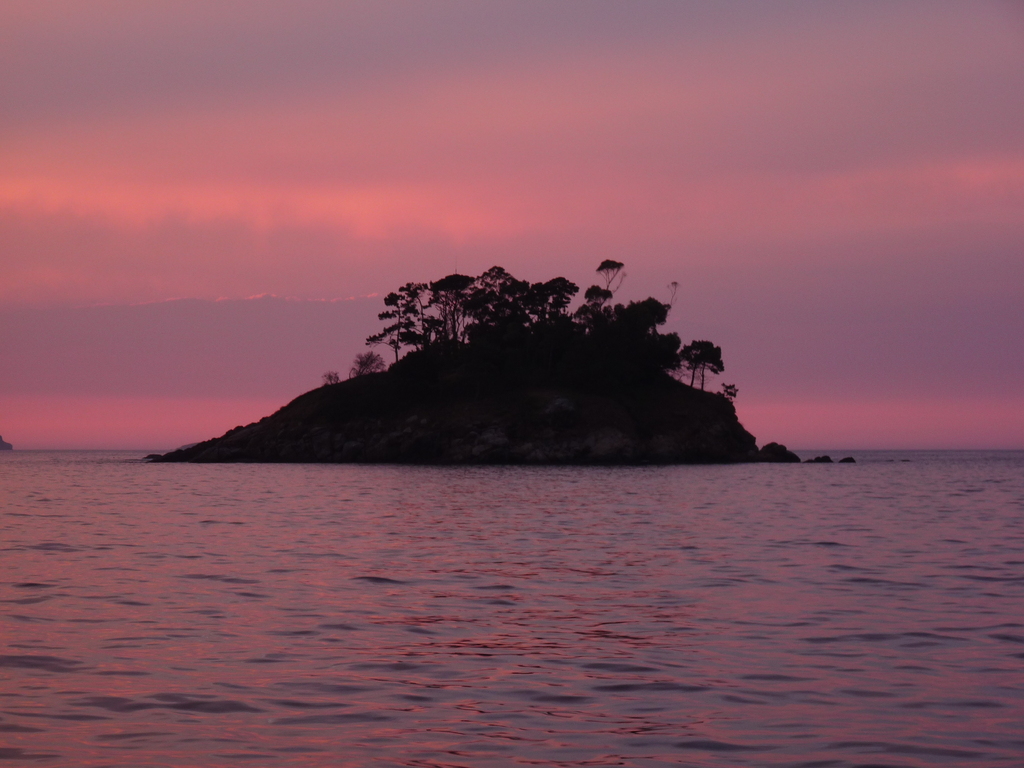
Sunset from our beach anchorage in Ria Viveiro
Islota at dusk
Sunset series III
The next day we sailed back in and walked to the pretty medieaval town of Viveiro from the beach. We enjoyed a wander around the walled town and stopped at the tourist info on our way back. 'You are lucky, there is a fiesta in Celeiro tonight,' the woman said. Apparently the night before was the festival to honour Santiago (fair enough - he's Galicia's patron saint), and this night was the turn of Santa Ana (Christ's grandmother - eh? No doubt she would have been delighted to know how her day would be celebrated thousands of years hence.). On a board outside the tourist info, two more festivals were listed for Friday and Saturday nights. Before the rumbling of the thunder flashes, we were off, back to our beach anchorage.

Castropol in Ria Ribadeo 
Lateen rig in action (especially for Marco)
Our anchorage on the Galician side of the ria
The library in Ribadeo is in urgent need of TLC
Local sailing dinghy fleet, all with lateen rig
A glimpse of the Asturian hills
With no end of festivals in sight and decent wind forecast, we deemed it prudent to move on the next day. Alas, there was not much wind and plenty of northerly swell. Still we made it into the last of the rias, Ribadeo, in hot, sunny weather. This, sadly, is our final stop in Galicia; we can see the green hills of Asturias across the water. One last meal of octopus and pimientos de Padron in the bustling town of Ribadeo and then it's on to cider and meaty bean stews.

Before and after some elbow grease
P.S. A teak brightening tip from the skipper: Scotchbrite + salt water works wonders. No expensive product or harsh chemicals needed.