Saturday, 23 June 2012

The end of the world

Cabo Finisterre
We were aiming for Camariñas when we left Muros this morning and there was no reason to suppose we wouldn't make it. True, we could have got off to an earlier start, but for another infernal all night disco fiesta disturbing the peace of the night before. 1000 wasn't bad, considering, and the forecast of light northwesterlies promised a pleasant if long day's sailing.


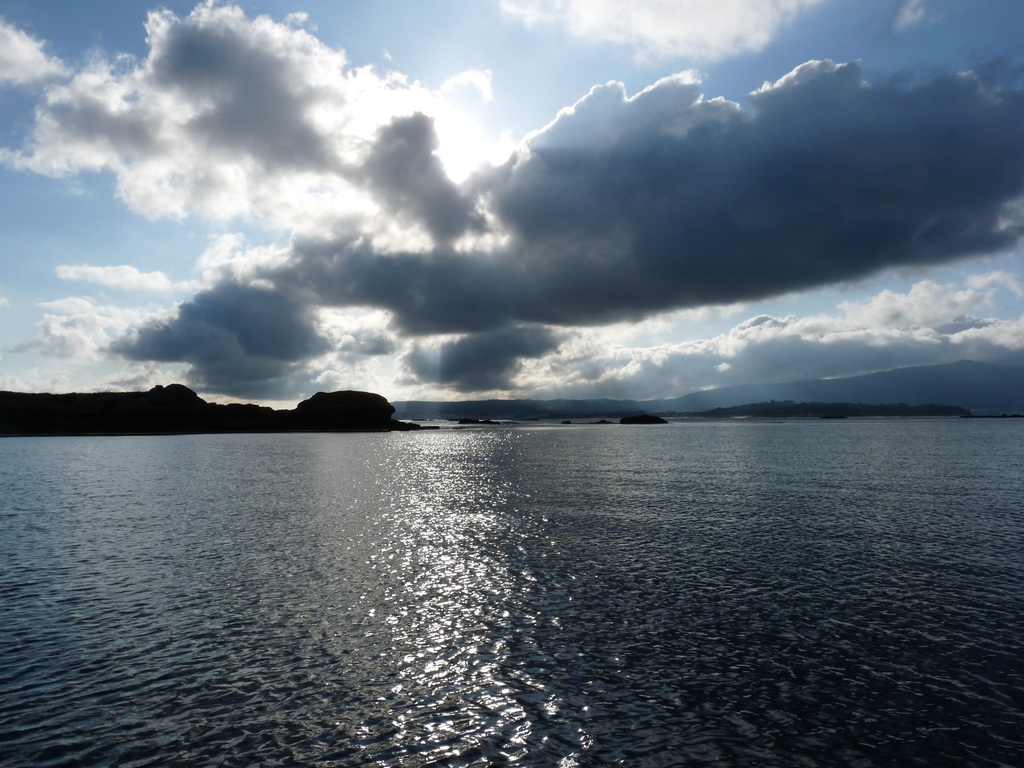
Long story short, it wasn't to be. The light northwesterly turned into a F6 on the nose around Finisterre and a rough ETA of 2300 was enough to convince us to pull in behind the sheltering arm of the western tip of mainland Europe.


Tomorrow, after all, is another day.

Fisterra village and the cape from the east
Early morning dolphin visit
View from the anchorage at Ensenada del Sardiñeiro
PS. We did make it to Camariñas the next day and had to motor all the way over a glassy sea. The difference a day makes! The anchorage at Ensenada del Sardiñeiro was well worth stopping, even though we had to endure yet another night of beach disco disruption - ear plugs did the job.

Friday, 22 June 2012

Operation clean-up


Looking back on Muros from the hills above.

The charms of Muros are holding us here yet. Chief amongst them must be the shelter of anchorage as the days have alternated fair with foul and we've sat out a couple of good blows along with heavy rain. We continue to enjoy the town as well and have come across an outstanding eaterie - the 'Nueva Escocia' - which appears to be simply a room in the owner's house with 4 or 5 small tables where he does everything himself, down to hand-cooking the crisps.

For months we've been on the lookout for a good tidal drying berth to give Fettler's grassy hull a proper clean and a fresh coat of antifouling paint. This too Muros has provided and two days of good weather with convenient tide times gave us the window we needed to get the job done. A subsequent jaunt all the way up the ria to Noia showed off the fruits of our labour as a good knot and a half has been restored to the vessel's speed. Unfortunately, there was no good shelter to be found at Noia so we returned to Muros for the night.

Bearded lady. The growth was slowing us down too much.
How we missed Joe and his pressure washer!
Clean again! Now for the paint...
Smooth as a baby's. Ready to fly through the water again.
The forecast for the next few days is looking good for rounding Finisterre, so we might just take advantage of it.

Thursday, 14 June 2012

If you're going to Santiago (be sure to wear a scallop in your hair)

800 years this year - the cathedral of Santiago de Compostela.
The country might be teetering on the edge of insolvency, but at least Spain seems to have a good infrastructure to show for all the lost dinero. The train we took from Vilagarcia to Santiago de Compostela was modern, clean, punctual and reasonably priced. Santiago itself was a delight.

It's a bustling and prosperous-looking city and of course a major pilgrimage destination since the tomb of St James the Apostle was located there in mediaeval times. There are still plenty of pilgrims about, concentrated in the historic centre and clustered around the cathedral, which marks its 800th anniversary this year.

These pilgrims wouldn't have looked out of place centuries ago.
The atmosphere was quite stirring, with a steady stream of arrivals, many of whom had walked or cycled 800 km along the Camino de Santiago. We had a bit of luck in entering the cathedral just in time for the swinging of one of the world's largest censers - La Alcachofa - a spectacular display before a packed cathedral.

Incensed - La Alcachofa in action.
A splendid organ too.
Unfortunates suffering in Purgatory.
Santiago boasts many other fine churches, museums, libraries and is a university town as well. We had been strongly recommended to visit the Museo do Pobo Galego (the museum of the Gallician people) and very worthwhile it was. Our friends the Kodiaks were particularly impressed by the triple helical staircase, telling us to go if only to see that.

Nice staircase(s). They don't all lead to the same places either.
The weather took a turn for the worse after our day in Santiago and we've been dodging from anchorage to anchorage with some fairly wild sailing in between. We also took our leave of the Ria de Arousa and thrashed around to Muros, beating into a heavy swell and weaving around the many inconveniently positioned clusters of rocks along the way.

Muros, from one of the surrounding hills.
Ria Muros is less built up and more rugged than the rias to the south and we've been taking advantage of the excellent hill walking opportunities. Despite the tourist office's assertions that 'Muros deserves to be gone round' and 'nobody can leave Muros without forgetting having stayed in a region full of artistic and cultural heritage, nature and sea', we would recommend it to anyone.

Heading ashore, aided by our trusty umbrella (Photo: A. Scott).
Rock hopping with the Kodiaks (photo: A. Scott).

Cute cottages there are in plenty. 
Hunting for the elusive Neolithic petroglyphs.
Found at last, no thanks to whoever tore down the signposts!
This place has it all. Gorgeous beach at San Francisco.

Thursday, 7 June 2012

Pontevedra to Arousa

This is Pontevedra! (photo: A. Eiris)
What a fantastic time we had in Pontevedra. It all started with the pint of Kentish ale mentioned in the previous post. We met the right people there - now our good friends Pedro and Carol - who welcomed us into their circle of friends and showed us where to go and when.

From them we learned a lot about Galician life in general, music and night life in particular. Things don't really get going until after midnight and then it continues for as long as you can keep it up. There's a superb live music scene and plenty of great chat. It felt somehow familiar, suggesting that the pan-Celtic connexion is more than just an idea.

The truly hardy call for aguardiente de cafe, which we dubbed 'the rocket fuel of Galicia', that delivers a compact hit of caffeine, alcohol and sugar and may possibly eliminate the need for (or ability to) sleep altogether. We left that stuff well alone and so would typically flag and fade into the night somewhere between 0300 and 0600. After six days of that the instinct of self preservation dictated that we move on, sorry though we were to say our farewells.

We didn't get very far the first day out, pulling in at the first opportunity (Sanxenxo) for some much needed rest. On the following day we made it around into the next Ria, Arousa, anchoring out here and there and keeping a fairly low profile while recovering from that week of Pontevedran debauchery.

We have managed to catch up with the Kodiaks again and enjoy some more of their company and had a visit from Sonja's cousin Melanie, which was very nice. Shorter than we would have liked, but thus is it ever.

The weather is a bit iffy at the moment. Looks like conditions are hellish in Biscay and the Channel but we're tucked up in Vilagarcia where it's showery and blustery but not too bad. Tomorrow we're planning an excursion by rail to the famous Santiago de Compostela.

Anchored in the Ensenada de Grove.
Dawn with a passing thundery squall.
View from Isla de Arousa.
Anchored at Isla de Arousa.
So many beaches.
Pobra do Caramiñal.


Thursday, 24 May 2012

Pint stop in Pontevedra

With a great effort we finally got up the anchor and departed our first Galician anchorage in the Ensenada de San Simon. It was such an effort because the place was so very pleasant. An anchorage with no rolling! The company was also excellent as we were hanging out with a Dutchman and an Englishman who sailed up there 8 and 12 years ago respectively - and never left. It was tempting, but we're not ready to swallow the anchor just yet.

Okay, so there's great anchoring, but that's not all. The sailing is also superb, flat waters without several metres of ocean swell, suggestive of a warmer version of our home cruising ground in the Firth of Forth, with dolphins.

Mussels are huge here, second only to cocaine we've been informed (not sure if that was a joke...). There are many many mussel rafts about, but they're not much of an impediment to sailing or anchoring. They yield millions of tons of mussels annually and are a major source of employment. The mussels are attached to ropes hanging vertically under the raft and amount to hundreds of tons when mature for harvesting.

Mussel raft, weighted with blocks of granite.
We stopped one night in Cangas, opposite Vigo, but were quickly frightened off by the marina fee (€21 for our wee boat!), though we liked the town and did some major provisioning there.

We left Cangas beating into a force 2 - slow but very pleasant - and determined to sail out of the Ria de Vigo and into Ria Aldan, a side branch of Ria Pontevedra. After about 4 hours we had to give up and fire up the 'iron genoa' as the wind dropped away and headed us all the way around. It was then a quick chug the rest of the way to a peaceful and beautiful anchorage which, however, proved to be not quite free of swell.

Ria Aldan - fine beaches, happy birds.
Our aim then was to move on to the anchorage off Combarro, at the head of Ria Pontevedra, but conditions looked quite uncomfortable when we got there so we cut that item from the programme and went straight on up the Rio Lerez to Pontevedra itself. The pilot book makes this sound quite a bold proposition, with dangerous shoals and low bridges to fray the nerves of the navigator and we thought long and hard about whether to venture in. Of course the pilot books are always very conservative in these matters and in the event we had plenty of water (minimum 4 m) and air draught all the way along to the Club Naval.

Club Naval de Pontevedra
Signage
Sanctuary of the Perigrinating Virgin
Some cool green in the city centre
Pontevedra is the ancient capital of the region and has a historical centre of fine granite architecture, liberally sprinkled with tempting cafes and bars. We were particularly delighted to discover 'O Gato Gordo' - a bar specialising in British beer! For the first time since leaving Dartmouth last July I supped a sumptuous pint of bitter: 'Bishop's Finger' in this case. We'll return there shortly for the broaching of a cask of 'Spitfire', another Kentish ale from the Shepherd Neame brewery. Bliss!

Sonja homing in on a tempting cafe
O Gato Gordo
Ahhhhh
Next door, a cat-dispensing hole in the wall
Making a deposit

Sunday, 20 May 2012

Idling up the ria

Sunset at Baiona 
Broken toilet seat repaired
Just a short update by email since we only have Kindle internet access here.
It has been serious rest and relaxation since we anchored off the
village of San Adrian, in the Ensenada de San Simon.

The anchorage at San Adrian, with mussel boats in foreground
Despite being near the motorway it is a peaceful spot. There's not a
lot to do ashore, so we've been catching up on sleep while it rains
outside and occasionally venturing ashore to stroll a bit and visit
the harbour bar.

The village of San Adrian
Traditional grain store
Wonderfully protected anchorage - easily the best since we left the
UK. A nice gentle introduction to the delights of Galicia.

Talking of delights: local smoked cheese
And another fine cheese of Galicia

Sunday, 13 May 2012

Gone *with* the wind

Farewell to Porto Santo
As was very often the case on the Atlantic islands, the decision to depart came suddenly with a fresh weather forecast with the destination likewise a surprise: Baiona, instead of Santa Maria. A week of southwesterly wind was simply too good an opportunity to pass up and so we have catapulted to Galicia, giving us the prospect of an entire summer in the Rias of northern Spain.

Finally the fellowship of Fettler and Roede Orm was forced asunder, with the Orms peeling off to the Gulf of Cadiz, but happily the Kodiaks were going our way, having likewise altered their planned Azorean route to suit the weather.

The day of departure was sunny and breezy and once we got clear of Porto Santo, with 700-odd miles of open ocean ahead, the pace was set for the rest of the voyage. Apart from a couple of half-day windless spells, the wind held true to the southwest, F5-6 - more or less tradewind conditions. The seas were moderately boisterous, forcing us to stick to a sail plan of poled-out working jib alone. Not the best setup for speed, but no worries about backing mainsail or jib and easy for the self-steering to deal with. It did make for a very rolly ride, and though no seasickness was suffered we didn't have much of an appetite either.

The rolling made everyday tasks, including cooking, awkward and we stuck to a stomach-friendly diet the entire time. What a healthy life we lead at sea - no alcohol, no tobacco, no coffee, small portions. We would start with a hot bowl of gofio in the morning, then have an apple, an orange and half a banana during the day, with maybe some dried fruit. Lunch would be crackers or crisp bread - with avocado until they ran out - and dinner a potato-based dish. We ran out of our favourite, instant mashed potato, on the fourth day.

It was mostly grey, with a fair bit of rain and rather cold by night (cold weather gear including the duvet and our Fladen immersion suits were dug out for the first time since the passage from England to the Azores).

The main excitement was provided by frequent dolphin visits. Every day but one we had good long sessions with highly energetic and acrobatic Atlantic white-sided dolphins. They were surfing down waves in formation and leaping out in synchrony, doing back flops and belly flops and of course porpoising and bow riding. They came by day and by night, showing off fantastic displays in the powerful luminescence during the darkest hours between sunset and moonrise. I have rhapsodised about glowing dolphins before but it really is one of the most amazing sights there are to be seen. The closest thing to magic there still is in this dull old world.


So long as we kept well offshore (100 mile minimum), we encountered very little shipping, maybe a ship a day. This changed dramatically when we turned in towards the mainland on the last day and crossed the shipping lane approach where they feed in and out of the traffic separation scheme around Finisterre. Then we were dodging ships from 0500 to 1000, with 6 to 8 of them showing at any one time on the 10-mile range of the AIS. The wind, of course, was dropping off steadily at this point, leaving us completely just as we were approaching the inner edge of the lane and forcing us to motor through the last bit to safety. Just at this point we were fortunate in dodging a bank of fog hanging about nearby. We could hear the fog horns of the big ships as they disappeared into the gloom.

Thereafter the last day was lovely, even though we had to motor, with the first warm sunshine since Porto Santo. We had stuff out to dry and sunned ourselves with wild abandon until - dah dah daaahh - the heavy fog bank rolled in. From hunky dory, things instantly turned to chill, drab and damp. From being able to see our destination, we were left to feel our way in for the last 5 hours in the fog and dark. A bit more excitement than we were really looking for at that stage.

Fortunately we are equipped for such conditions. On with the radar, on with the AIS, on with the chart plotting software on the computer! Also, on with the coffee. It was quite an absorbing task to keep an eye on all these devices, as well as a pair peering the boat length or so we could see into the fog. Visibility was zero. It was interesting to see how the radar and AIS still complement each other. Usually a passing vessel would appear on both but there were cases when we could see a target only on  one or the other.

It was only when we entered the bay that visibility was finally restored, much to our relief, and we happily made fast to the pontoon at Baiona at half past midnight, local time, after six and a half days at sea.

Flying the flags in Baiona.
On a 'tapas crawl' with the Kodiaks.
The ramparts of the fortress of Baiona.
Looking out to the Islas Cies.