Wednesday, 8 August 2012

Off the beaten tack

Plenty of room for other boats

Since crossing the border from Galicia into Asturias, we've been pretty much on our own. Occasionally, a French boat on its way past, east or west, stops for a night, but that's it as far as yacht traffic goes. The distances between all-weather entry harbours are longer here, with only three sheltered harbours (Cudillero, San Esteban and Aviles) between Ribadeo and Gijon on the other side of Cabo Peñas. We opted for San Esteban de Pravia as our base, 48 NM from Ribadeo and 25 NM from Gijon.

S Esteban river entrance. Ok today but we've seen winter pics
Anchored alone, in view of industrial heritage

A former coal port, San Esteban is now a charming, friendly little town with everything one could ask for - good transport links (train and bus), supermarket, general store, bank, pharmacy, five cafe/bar/restaurants, a beautiful coastal walk and perfect shelter in its large and fully dredged harbour basin. Its industrial heritage is nicely displayed with a row of cranes lit up along the harbourfront at night, and the final section of the old coal-transporting railway has been converted into a pedestrian path and park through the middle of town.

Even the most recent edition (2010) of the South Biscay pilot is pretty down on San Esteban. If we hadn't heard from a couple of boats who'd stopped in there that things were different, we would not have been tempted. True, until just a year or so ago most of the harbour was badly silted up but there is a dredger permanently based here and the port has just been dredged to around 7 metres, with small boat pontoons lining the quayside. The rest is used for dinghy sailing and other watersports or available for anchoring. This is what Burntisland or Granton could be like!

Along the clifftop coastal walk
Decay in the backwaters
Soto del Barco

True to what we have discovered to be our cruising philosophy, rather than be on the move all the time we've decided to stay for a couple of weeks or so in well-selected, sheltered anchorages along this coast and take the time to fully explore the surrounding countryside and towns. From San Esteban so far we've been to the cute fishing village of Cudillero, 3 NM to the west, and the historic cities of Aviles and Oviedo. This confirmed our choice of base port since Aviles, despite having a beautiful old town, has a horrible waterfront (the marina is next to a dual carriageway on one side, looking over to smoking factory chimneys on the other) and the wind whistles straight through the harbour at Cudillero.

Cudillero
Cudillero harbour - windswept but snug
Des res in Aviles 
Cobbled for cattle, smooth for pedestrians 
Rough night in Aviles?
Oviedo's Gothic cathedral 
Oviedo old town

The towns of northern Spain are very picturesque and lively and we find it hard to understand why there aren't more international tourists here (not that we're complaining, mind you). It's mainly pilgrims on the Camino de Santiago and Spanish visitors. But then we hadn't heard of Oviedo, the capital of Asturias, or Aviles, its third largest city, before we came here, either. Highly recommended.

The local beverage, sidra, has become a favourite. It's an uncarbonated, unfiltered cider which is served by pouring over one's shoulder into a very thin glass held far below to give it some fizz. You're then supposed to down it, but that seems rather wasteful.

Asturian still life

Today we have a day off from sightseeing and join the local grannies what lunch, all dolled up in colour-matched dresses, handbags, shoes and cars, in a pre-lunch drink with pinchos on the terrace of the 'Puerto Norte'. Prior to lunch, that's also where one can find a rare beast in this part of the world - a strokable cat - who  most days seems to spend the late morning curled up on one or other of the cafe chairs.

Sunday, 29 July 2012

Nossa Nausea


Ria Viveiro

Driven by our need to escape from all-night fiestas, we have made some progress along the coast. We are beginning to get the sneaking feeling that we arrive in each town just in time for the annual fiesta, but, more likely, the Spaniards simply party all the time. Maybe they need something to take their minds off the 'crisis'.

Now 'fiesta' sounds like fun and we are not normally known to be party poopers, but these affairs last all night (6 a.m. minimum) and are taken to be a great excuse to make as much noise as possible. This makes sleeping in an anchorage nearby almost impossible. It wouldn't be so bad if the fiestas had traditional music and local flavour - however, it's always the same Latin disco tunes, sometimes by a live band or orchestra and sometimes just a disco with some maniacal DJ screaming into the mic. There are only so many times one can listen to Nossa Nossa, Lambada etc. and we already exceeded that quota in the Canaries during Carnival, way back in February!

The night before we left the Ria Santa Marta de Ortiguera, a Tuesday night, was possibly the worst offending fiesta yet. It wasn't even in the town where we were anchored but one village over (a couple of miles away), but the amplification was extreme and the band bad. They only played one third of a tune and then screamed for a few minutes, to the accompaniment of some fiendish bass generator, before attempting the next song. Since we had planned to get up at 7 a.m. to catch the tide out over the bar, this was exceptionally poor timing.

We had a lovely sail beating along the coast to the next ria, Viveiro. It turns out that the prevailing summer winds are northeasterly on this coast and there is a knot of current running west, but that just makes us feel at home. We rounded the breakwater at Celeiro only to hear thunder flashes going off (the sure sign that a fiesta is beginning) and the usual Latin disco music starting up. A quick turnaround and we anchored at a peaceful beach around a headland from the shennanigans.

Sunset from our beach anchorage in Ria Viveiro
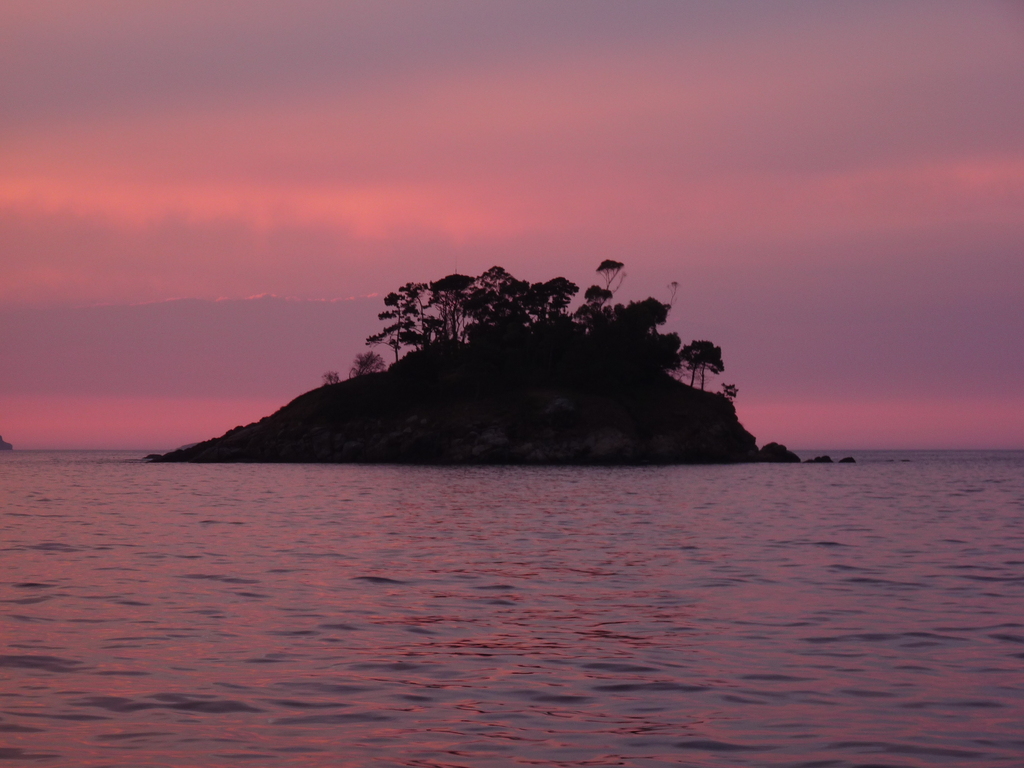
Islota at dusk
Sunset series III
The next day we sailed back in and walked to the pretty medieaval town of Viveiro from the beach. We enjoyed a wander around the walled town and stopped at the tourist info on our way back. 'You are lucky, there is a fiesta in Celeiro tonight,' the woman said. Apparently the night before was the festival to honour Santiago (fair enough - he's Galicia's patron saint), and this night was the turn of Santa Ana (Christ's grandmother - eh? No doubt she would have been delighted to know how her day would be celebrated thousands of years hence.). On a board outside the tourist info, two more festivals were listed for Friday and Saturday nights. Before the rumbling of the thunder flashes, we were off, back to our beach anchorage.

Castropol in Ria Ribadeo 
Lateen rig in action (especially for Marco)
Our anchorage on the Galician side of the ria
The library in Ribadeo is in urgent need of TLC
Local sailing dinghy fleet, all with lateen rig
A glimpse of the Asturian hills
With no end of festivals in sight and decent wind forecast, we deemed it prudent to move on the next day. Alas, there was not much wind and plenty of northerly swell. Still we made it into the last of the rias, Ribadeo, in hot, sunny weather. This, sadly, is our final stop in Galicia; we can see the green hills of Asturias across the water. One last meal of octopus and pimientos de Padron in the bustling town of Ribadeo and then it's on to cider and meaty bean stews.

Before and after some elbow grease
P.S. A teak brightening tip from the skipper: Scotchbrite + salt water works wonders. No expensive product or harsh chemicals needed.

Monday, 23 July 2012

Go slow

Managed wetland
Sluice gates down
Still swinging on the hook in Ortigueira, kept here by the beauty of the location, shelter of the anchorage and a spell of easterly winds. This is a spot with plenty to offer though and it's only after about a week in place that we feel we're starting to get a proper feel for it. There are surprisingly few visiting boats here. There hasn't been more than 4 at any one time and most seem to stop a night or two at the most.


Half tide
Much of the ria is only navigable for vessels with under a metre draught, which makes it ideal for exploring by canoe. Our preferred tactic is to canoe to some spot where we can hike from and get a bit deeper into the surroundings.


She only wanted to chew my sandals, not say hello.
In the belfry
From the belfry
Pearls of wisdom
Pozo de Inferno (a pretty mild vision of the inferno)
Castelo de Cason
The interior
When we're not exploring, it's good to come into the local bar/cafe/internet place and get caught up online. A great thing in Galicia (and hopefully other parts of Spain as well) is the very civilised tradition of offering a small snack with the beer. This place, the Alameda, is particularly generous. With a caña (about 300ml of draught lager), you get a bowl of crisps and a pincho, a small plate of whatever their tapa of the day is - zorza, paella, what have you. Thus, after a couple of beers, one has also eaten well and cheaply.

Tuesday, 17 July 2012

Celtic connexions

Coruña's Torre de Hercules, world's oldest working lighthouse
We had a super time in A Coruña, largely thanks to our local friend Ana who we met in Pontevedra. She, of course, knows all the top tapas corners to aim for and under her tutelage we partially adapted to Spanish eating times, getting in an extra meal between ten and midnight. The Club Nautico marina wasn't toooo expensive and is perfectly located in the centre of town. We treated ourselves to 5 nights (buy 4 get one free).

Ana was also very generous in taking us places in her car, including Lidl (yay!) and out to the Mediaeval Fair in the nearby town of Betanzos. This was an important place in mediaeval times and still has the look in its historic centre. The fair was attended by many vendors of olde-timey stuff and culminated in a licentious street theatre witch trial fireworks display.


Cabo Ortegal, another major cape rounded

In A Coruña we saw posters proclaiming an international Celtic music festival in Ortigueira, one of the next destinations on our itinerary. So, to get there in time, we reluctantly skipped Rias Ferrol and Cedeira and made for the super snug anchorage at Ortigueira.

It's quite exciting pilotage to get into this ria - for some reason the buoys marking the channel only begin halfway in, after crossing the bar and rounding the first bend, and it is impossible to get in or out with a northerly swell running. Once you are inside, the waters are totally sheltered - you can't even see back out to sea. We were expecting a lot of visiting boats for the festival, but there were only two others - both of which had only learnt about the festival after getting there.

The entrance to Ria Ortigueira at half tide
The channel
A careful choice of anchoring spot is necessary
Placid water inside

As usual with Spanish fiestas, this one was put on by the town council and the three nights of music were provided free of charge. We went ashore for the first two bands and then drifted back to the boat in the canoe, took in another band from the comfort of our cockpit and then slept through the final two bands of the night. Thus we missed a Japanese harmonica ensemble but did manage to see the Oban Pipe Band.

The set-up for the festival
The scenery around is striking, with walks all the way to the outside of the ria and some lovely beaches. Looks like we'll hang around a while now that the festival crowds have left and the town is returning to its normal sleepy self.

Railway bridge at Ortigueira
Here, after just over a year on board, we made a major advance in onboard showering technology. The black bag solar shower never thrilled us, due to its trickle delivery. The garden sprayer had the pressure but didn't heat the water so efficiently, despite painting it black. Sounds obvious now, doesn't it? Heat the water in one, spray it from the other. Wonderful hot shower in the cockpit.

Another flash of inspiration has led to the use of our mosquito net as a partial sun shade for the cockpit. The more functions each item on board can serve the better!

Wednesday, 4 July 2012

Along the Coast of Death

Since being forced back on our first attempt to beat around Cabo Finisterre we've had no wind for sailing, meaning a longish motor along the length of the Coast of Death where frequent fog and many rocks can make an unpleasant combination for sailors. It's a beautiful dramatic coast but with few refuges for boats.

We holed up a week in the Ria Camariñas, a lovely Ria and the best shelter along the Costa de la Muerte. Great hiking around the area and a very friendly bar/cafe at the marina. We treated ourselves to a few days in the marina, making the most of the shower facilities, and then moved out to the anchorage just in time to sit out a hard southwesterly gale.

The holding was good, once the anchor punched through a thick layer of weed to the mud below, but several boats dragged during the peak of the storm, some re-anchoring, some relocating to the marina for the duration. When we eventually hauled anchor, it brought with it the most almighty clump of assorted weed we've seen yet.

Fog rolling in over one of the many wind farms
Carpets of wild flowers along the foggy Coast of Death
The fog bank rolled in most afternoons
Cabo Vilan lighthouse just visible
Gorse and wild flowers along the coastal path
The heather's in bloom
The biggest winkles we've ever collected
Despite any rumours you may have heard to the contrary, the Rias Altas are just as beautiful as their southern counterparts. We're now in Ares, just to the east of La Coruña and back in company with the Kodiaks, with whom we took a long walk yesterday across to the Ria Ferrol. Ferrol is quite spectacular, guarded by a narrow entrance flanked by ancient fortresses that has historically made an impregnable refuge for the Spanish navy. Following a weekend visit to Coruña, we're aiming to check out the anchorages of Ferrol before ambling on eastwards.

Mugardos in Ria de Ferrol
The scenic part of Ria de Ferrol
Coastal path near Ares
Ria de Ares