Tuesday, 6 September 2011

Pineapples and cheese

We finally tore ourselves away from Ponta Delgada and our great friends on Sao Miguel and got underway again.
Before leaving though, there was time to go with Ricardo to his father-in-law's pineapple plantation just outside Ponta Delgada. Pineapples are a traditional crop of the island, grown in glass houses in accordance with a series of mysterious rites, including lighting a fire in the building to smoke the plants and induce them to produce fruit synchronously. Each plant produces one fruit and takes a year to do it.

Baby pineapples!
We didn't go away empty handed, the boss fellah being sure to harvest one ripe pineapple for us to take home and enjoy.

The forecast we left on wasn't ideal, but it looked like the best in the immediate future so we went for it. It was a wrench to leave but we gritted our teeth and cast off the warps regardless. The wind had been blowing stiffly from the north for a couple of days so we expected it to be rough once clear of the island and so it was. At least we had the pleasure of 'stealing' a pod of dolphins from the whale watching boats as we sailed past.
The following day we got within striking distance of Pico and Sao Jorge and began to feel the bizarre effects of these high mountainous islands on the wind. At times it was pleasant sailing, at times hideous. The wind changed direction and strength all the time, dancing between 10 and 26 knots unpredictably. Finally it settled stiff and on the nose as we tried to beat up the channel between the two islands towards Velas.
A possible anchorage at Calheta became very tempting as the day was drawing to a close but the fact that it's not a port of entry was a problem and the pilot book didn't make it sound very attractive either. However, we were tired and really didn't feel like thrashing up the channel all night so pulled in to Calheta after all and were very pleased we did.
It's tight for space, but there were no other boats in the anchorage and only one fishing boat unloading on the pier. We dropped the hook near a dodgy looking mooring buoy and crashed out at about 2200, to the melodious strains of the Cory's Shearwater.
I woke up around midnight and had a look out, not feeling too confident in the holding, and was dismayed to see a small sailboat tied to the dodgy looking mooring. Should the wind shift in the night, we would almost certainly collide. There was nothing for it but to haul the anchor and move to another spot. This turned out well though as we found better holding the second time and slept soundly thereafter.
In the morning we found the wind in a much more favourable direction but still highly variable in strength as it poured over the mountains from the north and down into the channel. Still, it was a nice sail until the final approach to the harbour at Velas, where it was seriously howling. No matter. We had reached Sao Jorge, the island of cheese, and settled quickly in at the small and friendly marina.
The town and the island in general are, you won't be surprised to hear, beautiful.

The central square of Velas.
One of the famous Sao Jorgian cows, with Pico, Portugal's
highest peak, in the background.
An escaped hen, returned to the wild, with her newly hatched
and very cute brood in the forest.
The season is more or less over here so the marina, which is normally packed out, has ample room. There is only one other visiting boat here at the moment, another of 'our type' of vessel. Malu is a Danish 27-footer, belonging to Frank and Lone, whose company we have certainly been enjoying.

We had quite an exceptionally good day today, setting off to hitch hike to the northern part of the island. Getting lifts was easy enough, the first in the back of a pickup truck full of bags of sugar, taking us to the village of Norte Grande. From here we hiked down to the Faja Ouvidor. The island is seriously steep-sided, only broken by the Fajas, which are the sites of ancient lava flows to the sea.

Faja Ouvidor, looking to the next Faja along. The Fajas
were the first part of the island to be settled.
Bar Azul, next to the wee harbour, where we stopped for a
 cold glass of red wine. Well within budget at 80 cents.
Where the lava met the sea. We had spotted a tempting looking
swimming spot and were prospecting for the route to reach it.
The view from above. We just had to swim in these pools! 
Finally! On the fourth attempt, a route down was discovered.
We had the place entirely to ourselves.
Columnar basalt and clear turquoise water.  
Heading back over the lava bridge.
Returning home again, we first got a lift with a friendly farmer who took us as far as the first field of cows he had to milk. He invited us to view the evening milking, which we were glad to do, and then gave us as much fresh milk as we could drink and carry away with us. A lifelong wish for both of us fulfilled - drinking milk fresh from the cow! Not just any milk either but delicious Azorean milk.

'Form an orderly queue please, ladies'. The cow that our milk
came from. The milking machine was run by a generator
on the spot.
Lastly, we got a lift from a very nice chap living in Velas, who invited us into his home when we reached town and fed us well on bean stew and plenty of the famous Sao Jorge cheese, washed down with red wine and a very local aguardente. This is a friendly island!

Saturday, 27 August 2011

Cooking underground

Yes, we're still in Ponta Delgada.
We've been busy with both boat maintenance and having fun. First, the fun.
Marco and Marcia prepared a cozido for us. This is a traditional dish of mixed meats and veg, cooked in a large pot buried in hot ground next to thermal springs. The pot is buried for 6 hours' cooking time. It's also traditional to eat until you feel as if you'll burst. Some cozido recipes include less savoury ingredients such as pig's ears and chicken feet, but ours was all high quality deliciousness: chorizo, morcela (blood sausage), pork, chicken, another sausage, yam, sweet potato, potato, cabbage and carrot. Yum!

The burial ground. Numbered sticks indicate individual pots.
Marco with the disinterred booty.
Heading for the picnic spot, next to Lagoa das Furnas. 
Unwrapping. 
Captivating aromas were already reaching us at this point.
Avast! The cozido. Ingredients are built up in layers.
That's cabbage on top.
The head chef dishes up.
Tuck in! There was an incredible amount of food.
Enough for 10 at least and only 4 of us to do our best.
Afterwards, groaning over drum-like bellies, we headed into the village, where Marcia's aunt and friends gather nightly next to a hot spring that provides an endless source of boiling water for making coffee. We brewed up a cup, enjoyed, then took the cup across the road to the hot dishwashing spring, then along to the sparkling mineral water spring a few yards further along. Amazing.

The coffee-making spring is just down the stairs.
And the work.
It's also been a good time for boat maintenance, with plenty of warm dry weather.
First up, the companionway seat. On the way here from England, I had given some thought to the problem of sitting comfortably in the companionway. It's the best spot for keeping watch, particularly in inclement weather, but it's a bit hard on the posterior, being unforgiving and narrow. By the time we reached the Azores, I had a design in mind. Our good friend Joao had already offered to help with any small carpentry projects so I went to him with the plan.
It so happened that Joao had some lovely timber in stock, having harvested some cedar trees on his property. The trees had been milled into plank form and were already well seasoned, so it was easy for Joao to cut the pieces I needed for the seat. I made the final fitting adjustments on the boat and epoxied it all together.

Every clamp on board.
Add three coats of varnish and a comfy seat is the result.
What else..? We were given a second spinnaker pole, which we wanted for our trade wind rig, giving us the option of flying twin headsails. It was a bit long so had to be cut to size. A second ring and car is being fabricated for the track on the mast.
All the winches on board have also been stripped down, cleaned and serviced. It's the first time I've done a full service on the Lewmar sheet winches. I didn't dare before as they had to be taken right off in order to fully disassemble the mechanism. It was a big job, taking two full days, including special adaptation of a flat head screwdriver to fit the huge screws holding the winch to the boat. I knew the winches were old, but wasn't sure if they were original to the boat. If I interpret the mark on the base correctly, they were made in 1973, so not original. Beautifully made, though design improvements since have eliminated the need to take the winch off the boat to service it.

How many moving parts?
A note from the Quartermaster:
We have now used pretty much every tool on board - even the ones I didn't know what they were for (centre punch set??). I'd like to apologise to the Skipper for any Lidl/Aldi tool purchases I may have opposed at the time.


Tuesday, 23 August 2011

Squid's in

And... we're still in Ponta Delgada. It's just so outrageously nice here we haven't got the heart to move on yet.

It's tough, but somebody has to do it.
We've been journeying around the island, visiting friends, old and new, enjoying being warm.

The iron-rich spring-fed stream at Lombadas, where delicious
sparkling mineral water flows straight from the ground.
Yesterday we bestirred ourselves early to go squid fishing with friends in Vila Franca. Actually, we should have been a few hours earlier if we really wanted to fish seriously but one must be realistic about these things.
Marco and Marcia getting the boat ready to go out.
Sonja sensibly applying sun lotion.
The boat is a modern build to the traditional island style, with a lateen rig, but there wasn't any wind to speak of so the old Volvo Penta did the work while the sailing rig stayed behind in the harbour. Marco comes from a fishing family, so he knows his stuff and has the right gear. Squid are found at the bottom, in depths of at least 200 metres and the lures are lowered down on a steel line from a drum mounted at the side of the boat. You then jig the lure, which looks more or less like a small fish with two rows of sharp spikes at the tail end, up and down a few feet until you feel something grab ahold of it and then the long reeling commences.

Success! Captain Marco and a denizen of the deep.
A well-mannered squid. No ink was sprayed on this occasion.
Early as it was, by our standards, we were really a bit late for peak squid fishing time and found the pros heading home when we reached the fishing ground. As a result, we only caught the one lula but we didn't leave it at that and managed to pick up a red grouper on the way back to the harbour. Squid and grouper together made a very tasty stew.

Yum!
Catch of the day. Okay, they're no whoppers,
but you should have seen the ones that got away.

Friday, 12 August 2011

Slowing down


Ten days later we are still in Sao Miguel. It took a while for our bodies to acclimatise (high humidity) and for our minds to stop rushing. There is no urgency now and we plan to take it slow.
It's a jungle out there.
We've been lucky in that our friend Ricardo has lent us his vehicle – an old pick-up with four-wheel drive. Our first drive in it turned out to be Jim's introduction to rally car driving. We went up the road next to Ricardo's house and holiday cottage. 'It's a good road,' Ricardo had said. 'You change to four-wheel drive, keep to the left and you get to the top of the mountain. Then you take the road down to Sete Cidades and brake, brake, brake.' The road turned out to be nothing more than a sandy track and we ended up driving around the volcanic crater at the top! The road down was so steep that Jim had muscle pains in his calves the next day from the constant braking. Luckily nobody came the other way!
Boat shed in the cliffs.
We went on a couple of beautiful hikes, one along the coast to the village of Ribeira Quente, where delicious horsemackerel are to be had, and another one to a waterfall and a pretty abandoned village near Faial da Terra. The coastal walk went past beautiful deserted beaches with small boat sheds built into the rocks and along bamboo-shaded paths along steep cliff sides. We spotted a small pipe coming out of a small stream and decided to taste the water. It was a carbonated mineral water spring.
Salto do Prego.
Sanguinho.
We have also revisited the thermal spring at Ferraria a couple of times. The best time to go is at low water when the hot spring mixes with the sea water to almost 30C. Marvellous.
So cute and yet so naughty: Bonita.
Other than that, we are enjoying having ample time to read, swim and hang out with Ricardo and his Labrador puppy Bonita. It's good to have some time to recover from all the effort of making the trip happen. We especially like being able to sit in the cockpit in shorts and T-shirts after sundown. A couple of nights ago we ate a barracuda caught from Ricardo's boat. No fishing success ourselves so far, but we are getting closer. Most of the fish we see are in the habour, where fishing is prohibited.
It's not all lazing around though. In a brief return to work, Jim helped to paint a boat yesterday. We also rebedded the stove pipe, which was leaking slightly.
Next week we're planning to move on to the central group of the Azores, taking in Sao Jorge, Pico, Faial and Graciosa.


Wednesday, 3 August 2011

In search of summer


Darting about
The rendezvous with the two Pauls and Roy went without a hitch and we spent a very pleasant evening in Fettler's cockpit, together with Joe and Jayne from the Canvas Factory, who gave us lots of great local tips. The first of which was to go to the Dartmouth Arms for pizza, which we duly did.

The next day was the day of the Seafeather self-steering installation on Hyskeir by yet another Paul. Things ran into difficulty immediately when it became apparent that the frame for this would not clear the rudder. There was talk about delays, remaking frames etc., until Jim got out the sheet metal saw and proposed cutting off the offending part of the rudder. Paul T. had to look away as Jim neatly sawed the top end of his rudder off and all worked out in the end.

The following afternoon we set off on a Corinthian cruise in company up the River Dart. A gale was raging outside, but we were hoping to be sheltered from it. Alas, it was not so and spray was whipping over the river and the wind was howling. The sky looked particularly black at Dittisham so we decided to pick up a mooring and wait for the squall to pass. Shortly after, the call came through on the VHF from the two Pauls wanting to just stop right where we were, but we coaxed them on around another bend where shelter improved.

To get to our destination, the pub in Tuckenhay, we had to go on a challenging zigzag course up a drying side arm of the river. Since we had the only working depth sounder we formed the avantgarde, with Hyskeir following, blissfully unaware of the times that we squeaked through depths of 1.4 metres! After only one brief grounding we made it to the pub, to find an enormous Ovni (a French-built aluminium boat, mighty expensive) taking up most of the mooring space. We were assured that it was perfectly safe to dry out next to a grassy slope further back. It was a beautiful, peaceful spot and the beer was good, but the poor skippers had quite a night of shenanigans to ensure a smooth drying out.
A well-earned pint at the Maltsters, Tuckenhay.
Scenic Totnes
The next morning we rode the tide up to the pretty market town of Totnes, end of the navigable part of the River Dart. The weather was still rubbish so after a delightful cooked breakfast and a pleasant stroll around town we went for a sauna to get warm. On our return from the congenial Albert pub we found the vessels heeling over at crazy angles (due to the lines from the mast still tightened from drying out at lunchtime) and not wanting to dry the boat out another night we decided to high tail it downriver in the twilight and pick up a visitor's mooring at Stoke Gabriel. Since Paul T. had our inbound track on his chart plotter, he formed the avantgarde this time, straining his eyes on the little screen, while we had a most enjoyable motor behind in the still evening air.

Back in Dartmouth we said a hurried goodbye to Hyskeir who headed off east and took Paul J. on board for one last sail. Since we had to bash to windward, we only went as far as Salcombe. The Salcombe Estuary is very scenic indeed, but it is also insanely busy. Coming in, we had to dodge countless ribs towing donuts, two dinghy races, kayakers, ferries, water taxis and etc. Too much! After dropping Paul and topping up with fuel and water, all we could do was drop the hook, drink some wine and collapse. We anchored upriver, back of beyond, about 2.5 miles from town and had to pay £7.20 for the privilege. This is the first time we had to pay to anchor and hopefully the last!

Up to the Azores
Our plan had been to make for the Scilly Isles and spend a few days there before heading to the Azores. However, as we emerged from the Salcombe Estuary into an unrelieved greyness of sea, sky and air, to rain and an unpleasant sloppy chop, we decided it was time to bid adieu to Olde England and go looking for the sun.

The wind was from the southeast at that stage, handy for a quick exit from the Channel. The sea state was outrageous, however, and it was not long before I was violently seasick. Jim gallantly held off until after the Lizard. It was a tough day and night, but it got us clear of the Channel and both sea state and weather improved. The wind turned westerly and stayed that way for the next seven hundred miles – an uphill sail all the way!
When conditions are poor, this is the most coveted spot on the boat.
It took a couple of days to recover from that first day, but some dolphins appeared to welcome us to the deep ocean and that helped. On day 4 we ran into fog, which enveloped us for the next 300 miles! Without the AIS, this could have been an edgy time, but as it was we set the CPA (closest point of approach) alarm to one mile and relaxed. Jim radioed one big ship, which had been on collision course and altered course for us. We barely saw the colossus one mile away. However, despite the limited visibility, both a sperm whale and a minke whale swam close enough to be seen – maybe two boat lengths away. Jim was lucky to see the sperm whale dive: “I heard a rumble like distant thunder and turned round in surprise. It wasn't distant at all, it was right there – the Leviathan – an enormous brown mass that rolled slowly forward, raised its tail flukes (nearly as long as the boat) high and sounded to the deep.” The fog played havoc with our Tacktick solar-powered wind instrument, whose battery ran down for the first time ever due to the lack of light.

We finally emerged from the fog at 44N, 17W on day seven, described in the log as 'the first day without discomfort'. At last we could sit in the cockpit without oilskins! From now, the weather improved rapidly. Soon we only needed to wear the oilskin bottoms at night, then no oilskins at all but still sea boots (very impressed with our new Yacht Boot Company neoprene-lined boots, by the way) and before much longer we were barefoot round the clock.
A typical sea-going cockpit scene. Topping up the battery on a sunny afternoon.
And airing out the bedding.
Sadly the wind died as the weather improved and we had a 48-hour motor to get west and find some more. The wind in the last few days of the passage was very fickle and changeable, but we did have one beautiful starry night of downwind sailing.
At last! A bath after 9 days at sea. Water temp: 20C
We ate very well throughout the crossing, thanks in no small part to the tinned goodies donated by the many good friends who came along to our leaving bash. Highlights included cassoulet (in the thick of fog), wild boar ragu with pasta, Turkish white cheese on Ryvita and Tesco's finest ham on water biscuit. The fresh supplies lasted the entire trip; we arrived in Ponta Delgada with four potatoes, one onion and one orange left. For breakfast we always had porridge, made with milk powder, brown sugar, desiccated coconut and banana or dried dates. The new paraffin stove worked out very well, especially the gimballed tray for putting stuff on while cooking in a running sea. The new 3.5-litre pressure cooker also came up trumps and saw a lot of action: dhal, stews, soups, risottos and plain old steamed potatoes (served with olive oil or tinned fish) are staple pressure cooked dishes.
Coffee time. Relatively rare at sea.
Jim spotted Sao Miguel at 0700 on day eleven and we had a lovely sail around the island to Vila Franca do Campo where we'd decided to anchor next to a small island, not wanting to spend a night on the exposed concrete reception quay at Ponta Delgada. We arrived at the Ilheu around 1900, saw the anchor hit the sand in 7 metres and went for our second swim in 11 days. The sea temperature was 21C – we had found summer at last.
The Ilheu da Vila. A shallow lagoon formed from a volcanic cone.
Day 12 was just supposed to be a gentle sail, 11 miles to Ponta Delgada, but turned out to be a hard four-hour thrash into a Force 6. We arrived pretty shattered but delighted to be in, concluded formalities with the authorities and caught up with some friends. There have been lots of changes in Ponta Delgada since we were last here three years ago: new marina, new waterfront, half-(and seemingly never to be) finished casino. The new marina looked nice enough, but as we found out to our cost, peaceful it ain't. We were craving for a good long night's sleep only to be kept awake until 4am by an outrageously loud bar, where a cover band butchered one classic after another. The next morning Jim went straight along to the marina office to spend some time with his friends there, drank coffee, invoked the spectre of a tearful wife (tears of rage, more like) etc., and ultimately secured a coveted berth in a peaceful corner of the old marina where we have since managed to catch up on sleep.

Days sailed: 11.5
Hard on the wind: 8 days
Fog: 3 days
Becalmed: 3 days
On port tack: 7 hours
Water usage: 60 litres (2.5L per person per day)
Fuel consumption: 40 litres
Ryvita consumption: 5 packs
Fish caught: 0
Species of whale spotted: 3

Friday, 15 July 2011

Thames, Dover, Wight, Portland


Wild weather at Orford.
We hunkered down in the River Ore for a few more days while the southwesterly gale raged and passed our days very pleasantly with country walks, reading and a superb celestial navigation lesson from Orford Sailing Club's 'Doc' David, who had sailed his boat to Brazil a few years back and is a fount of knowledge.
The first day that the wind moderated we were on our way, along with a lot of other boats who had been waiting up river. As on the entry over the bar, departure is recommended at or above half tide on the flood and there was a regular flotilla steaming out against a pretty stiff current. We crossed the bar slowly and without incident but as soon as we were clear the seas started to hit us. Conditions on the Thames Estuary were still very rough and as Jim knelt on the foredeck, reefing down the jib for the stronger than expected wind, the bow regularly plunged into the approaching waves, engulfing him in solid water. At least it was warm.
We soon decided that it would be wiser to forget about the Channel and divert to the River Orwell. A tough beat into a good Force 6 finally brought us there after six hours of hard graft and we anchored at dusk in beautiful calm waters opposite the Suffolk Yacht Haven.

The River Orwell is extremely busy but mainly with sailboats – it's fantastic to see so many people out sailing, many in beautiful classic boats. Sailing conditions were near perfect, smooth water, gentle breezes. We were content to tack our way down river to Harwich's Halfpenny Pier to do our chores. People were very friendly – Jim got a lift to the distant petrol station from a a very nice chap from the cafe on the pier to get diesel and he was also given a pair of fresh-caught crab by local fishermen! The harbourmaster took our rubbish away with him and cast off our lines. Full marks for Harwich.

We then had a delightful downwind upriver sail to Pin Mill, where we cooked and ate the crab and then went ashore to meet Nicci, a friend of a friend who lives on a beautiful 100-year-old Thames barge. Pin Mill has a community of house boats that have been parked at the edge of the forest and boasts a fine pub in the middle of it. Just a wonderful peaceful place.

The next day we finally had a favourable weather window for the English Channel. A northeasterly was forecast to arrive in the night and strengthen to near gale the next day. So off we went! We were off North Foreland just as the tide was turning in our favour and at 3am the promised northeasterly came up. We poled out the genoa to one side, boomed out the main to the other and Fettler spread her wings and flew through the Straits of Dover at 7 knots plus. As expected we didn't get much sleep that night, maybe an hour or so each, what with changing conditions, all the traffic and having to handsteer most of the time. Luckily once the traffic separation scheme started the big ships all stayed nicely in there and we had the inshore traffic zone pretty much to ourselves.

Conditions became progressively more boisterous down Channel and we changed down from genoa to jib no. 3 as the sea state roughened. We were surfing down waves at 8 knots or more a lot of the time and making excellent time along this slightly dreary coast, past Dungeness and Eastbourne. At the Isle of Wight we had a slightly unnerving encounter with a ferry which steamed out of the Solent at 18 knots (the AIS said it would miss us by 3 miles at this point), then it changed course twice, slowed right down and came to a halt about half a mile from us and put two red lights on (meaning not under command). At this time Sonja panicked, thinking about the poor Ouzo, which had been mowed down by a ferry very close by, but Jim got up to help and we got out of the ferry's way – or so we thought. A few miles further, one of the self-steering lines broke and we had to reef down as conditions got rougher so we hove to fix this. By this time Sonja was horribly seasick and Jim gave up most of his valuable snooze time to do double duty. In the end, Jim had to call up the ferry, which had by now got under way again and was coming up on our exact course behind us at 18 knots. Why do these things always happen in the darkest hour of the night? Soon afterwards we were on collision course with no less than the Queen Mary 2, but at least that was easier to resolve.
We passed her in a blaze of light and thought of the passengers tucked up in their luxurious beds, probably not even aware that it was rough out at all.

The morning brought gentler conditions and sunshine as we approached the Portland Bill. Sonja got over her seasickness and we motored across Lyme Bay until a nice breeze started up on our nose – too good to pass up. We changed plans and went where our tack took us, which was into Torbay, where we anchored just before sunset after a passage of about 290 miles in 57 hours. After a celebratory beer and dramette in the cockpit we fell into bed, exhausted but well pleased.

Chuffing from Paignton to Kingswear.

The next morning was glorious. We spotted three species of heron in the woodlands next to the anchorage and a steam train chuffed along the coast. Somewhat reluctantly we got under way again to go around the corner into Dartmouth. The entrance into Dartmouth is just spectacular – what a beautiful town and superb spot. There are around 1,500 permanent moorings on the River Dart, plus countless visitor moorings. We were very pleased that there was a cheap-ish pontoon for boats under 30ft only, just outside the Dartmouth Yacht Club. This is where we'll be for the next few days while some more heavy weather passes by.
The entrance to the River Dart is out of this world.

Tied up in front of the Dartmouth Yacht Club - Kingswear across the water.

By chance we spotted the Round Britain Experience vessel in port, which we did ten years ago. We were welcomed aboard (much more luxurious accommodation than in our day) and later had the whole gang for drinks on board Fettler. Now we await the arrival of tiny Hyskeir and two other sailing friends – could be party time again tonight!


Tuesday, 5 July 2011

Go!


Granton to Whitby

The Red Arrows give us a rousing send off.
Well, we finally managed to begin our voyage. It wasn't easy. We had settled into our wee corner of the harbour very comfortably and were enjoying the social scene immensely. There was time to potter about the boat, getting things into a more refined degree of readiness and it was nice.

Then came the leave-takings, always difficult. The morning of departure, nerves were jangling slightly but we still had jobs enough to do to keep us from dwelling on it until finally the moment came to cast off the warps and go. Me mum was waving from the pontoon, a small group of friends from the Club were there to provide an escort out of the harbour in the launch, we hoisted sails, cut the engine and were away. There wasn't a dry eye on the boat.

The Bass Rock: Generating gannets since 1633.
As we sailed down the Forth the emotions gradually settled and we started to really enjoy what turned out to be a cracking sail down the coast to Whitby. The journey was more or less without incident, though there was a bit of hairiness in passing the Farne Islands during the night, just at a change of watch. The only moment of drama came after the wind died with about 30 miles to go.

We were chugging along merrily when the pitch of the engine suddenly dropped a note and we seemed to lose thrust. After a bit of diagnostics I concluded there must be something fouled on the propeller so we cut the engine, downed sail and I donned wetsuit to go have a look. While we were bobbing around before I went over the side what ever it was (probably a plastic bag) must have been shaken loose as there was nothing there by the time I got under and thereafter everything was fine. It was no bad thing to have a bit of a bath anyway.

The main consequence of this unscheduled pause was that we missed the last bridge opening of the day at Whitby but this turned out to be a stroke of luck. It saved us a night's pontoon fee and we ended up rafted up against an old acquaintance whom we met last year in the Caledonian Canal. We hoped we might bump into the crew of the Specsioneer and there she was.

The Specsioneer

It was good to catch up with owner Bryan and trusty crew member John and next day we went out on one of the 25 minute sailing tours aboard the Specsioneer, even taking the helm for a time. All good fun.


Whitby is a very pleasant town and we enjoyed seeing the sights, visiting the Captain Cook museum and receiving a visit from good friends Dan and Jenny and their three super children, Benedict, Emma and Lucy.

Post fish suppers.

Whitby to Orford Haven

It was with no very clear idea of where we would end up next that we departed Whitby bright and early on Saturday morning. Bryan had advised us to be on our way early doors to take advantage of the south-setting tidal stream, so we made our way through the swing bridge at 0530 and launched headlong into one of those motoring marathons that come with surprising regularity in long-distance coastal sailing.

The forecast said there wouldn't be any wind, right enough, but one always hopes the forecast will be wrong when it doesn't suit and besides, the wind was forecast to be southerly when it returned and we certainly didn't want that. So, we motored. On and on, through fair tide and foul, day and night, till our eardrums were bursting with it. Past Flamborough Head, across the Wash, and amongst the Winterton shoals.

Lowestoft had been considered a possible stopping place but looked a bit too industrial and too busy and we wanted to reach a spot where we could anchor up and relax for a few days to wait for a favourable wind to tackle the Channel. We passed Lowestoft during the afternoon of our second day out from Whitby. Passed it very slowly as we bored our way into 3 or 4 knots of foul tide.

Gradually we had settled on either the River Ore or the River Deben as a likely hole to drop into and relax for a few days but the timing wasn't right. With the tide turning in our favour we would reach Orford Ness around midnight, during the darkest hour of the night, which didn't seem entirely prudent. Also, entering either river is tricky and only to be attempted on a rising tide, at mid-flood, which wouldn't be until around 11 the next morning. Neither did we really fancy going on any further, as we'd be running into all the joys of the English Channel – one of the most congested areas of shipping on the planet.

Various ideas were bandied about until finally, at about 2230 as darkness was falling, we adopted the simple solution of doing nothing for a while. More specifically, we lay a-main for a few hours and drifted, in the right direction, with the tide.

The peace, with the engine off, tiller lashed down and the double-reefed main holding us into the bare 2 or 3 knots of wind, was shattering. The stars shone and the sea was nearly flat. It was gorgeous. I retired for a couple of hours of much needed sleep while Sonja maintained the drift-watch. Then, when we got under way again she was able to do the same during the last couple of hours before reaching the mouth of the Ore.

We piloted through the shoals near the coast and came to anchor between the two river mouths at 0530 on a very fair morning. After sleeping for a few hours, we fired up the Kindle and went online to check out the latest pilotage info on the river mouths, as the shoals are famous for frequently shifting around. We settled on the Ore and sure enough, the current configuration bears no resemblance to the chartlet published in this year's Almanac! I mean no resemblance. The channel now lies right through the middle of what used to be the shoal.

Armed with the freshest available info, we set off to cross the bar around 1100. There was a strong cross tide running and small breakers to either side but we crossed on a minimum depth of 2.1m and were safely into the Ore.

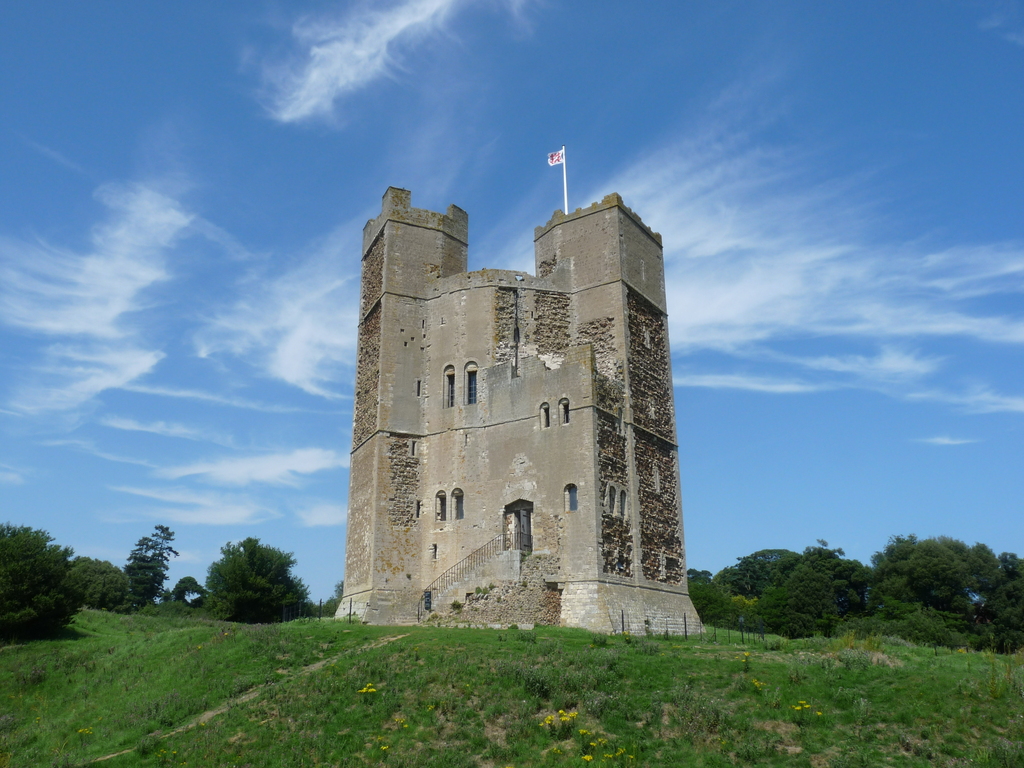
We dropped the hook in a branch of the stream next to a bird sanctuary island (reputed to be a favoured breeding ground of the avocet, though we've yet to spot one) and enjoyed the tranquil, warm and bucolic surroundings. Over the fields to the north, we could see the 900 year-old castle of Orford and its fine Norman church. Later, we inflated the canoe and paddled the couple of miles to Orford quay.


Orford is a splendidly English village. Charming old houses with pretty gardens and a couple of decent looking pubs, one of which we had to visit to sample some fine Suffolk ale (Adnam's Explorer). We were welcomed hospitably by a member of the Orford Sailing Club and invited to make use of their shower facilities, which we gladly accepted. From the local smoke house we purchased a delicious ham hock, cured in cider and treacle and smoked to perfection.

Joe Grundy was just out of frame.

The weather looks like cutting up rough from the south for the next few days, so we'll be happy to hang out here, possibly venturing further up the river to Aldeburgh, which has been warmly recommended, and doing a bit of bird watching.