Sunday, 20 March 2011

What a drogue


There have been quite a few projects running along in parallel this past winter. We'll write up a few of the more interesting ones over the coming weeks. This one got off the ground gradually, beginning when a friend asked me if we were planning to take a Jordan Series Drogue with us. "A what?" I replied, "Probably not." Further reading convinced me that it would be a very good idea to go to the trouble of putting one of these things together.

The Jordan Series Drogue was designed by aeronautical engineer Don Jordan, in the wake of the 1979 Fastnet Race, to prevent the capsize and damage of yachts in the open ocean in the event of a ‘worst case’ breaking wave strike, improve the motion of the boat in storm waves and reduce drift. Roger Taylor, for one, reckons it saved his life.

Depending on boat size, the JSD consists of 100 or more small cones or droguelets on a tapering rope of at least 80 metres, attached to the stern of the boat by a bridle. For our size of boat, the set-up is like this:

After weighing up costs, time and effort, we decided to order the cones ready made from Oceanbrake, source the rope separately (Barry Edwards) and do our own splicing and hooking on of the cones. 

First Jim had to learn how to splice the braid-on-braid rope. Then we had a few splicing evenings with a couple of friends, one of whom was making his own JSD.


The next step was the marking of the ropes to position the cones every 20 inches, with a 4-inch gap in between. Then the droguelets were threaded on.


Then it was time for hooking! There are three webbing straps at each end of each cone, all to be attached to the line. The webbing is threaded through the braid-on-braid rope most easily using a latch hook and tied off with a figure-of-eight knot. There must be enough slack for the cones to open out in the water. We found it worked to mark 5 ½ inches between the boat end of the cone and the previously marked attachment point for the webbing and then tie the knots very close to the end of the webbing at the other end.

Some must labour that others may live at leisure
Finally, the sections are attached to one another by cow hitching the soft eyes together. Some 10kg weight, probably a length of chain, will have to be attached to the end. The fully assembled drogue will be living in our cockpit locker in a mesh bag and hopefully it won’t see too much action.

That's a whole lotta cones, John

Packing it in the right order is important too. The foreman approves.
Finished article

Tuesday, 8 March 2011

A proposal

Although all's been quiet on the blog since the end of last summer, there has been plenty of action behind the scenes. For years we've been quietly plotting and building towards a proper voyage, one that will keep us out there for some time.
It was conceived in a daydream of paradisal South Pacific islands, suckled on the literature of Tom Neale, John Caldwell, Nick GraingerVictor Clark and others, raised on the Patagonian tales of fellow sailors met in the Azores and now approaches maturity, as we slog our way through the jungle of preparations between ourselves and our intended departure at the end of May.
I don't want to get involved in grandiose and hubristic claims about what we're going to do, but we have put together a rough outline of what we might hope to accomplish in the first year.

Sunday, 1 August 2010

In summary

Over the top

We had decided to go back to the east coast over the top of Scotland. The 115-mile leg between Stornoway and Stromness in Orkney was very unusual in that we had no wind! We had to motor around Cape Wrath across an uncharacteristically glassy sea. A skua kept us company for a while leaving Stornoway and we saw quite a few dolphins, but they were too busy hunting to do any bow riding. These northern dolphins seem to be a bit more business-like than their southern cousins.

Skua over Lewis

We had planned our arrival in Stromness to coincide with the last of the east-going tide in the Sound of Hoy, where tidal streams run up to eight knots. We were right on schedule as we approached the Sound of Hoy at 5 in the morning. However, we'd been able to see a fogbank hovering over Hoy and mainland Orkney from 15 miles off and it didn't budge. We had to make our way into Stromness in thick fog, with both radar and chart plotter keeping us straight.

Stromness
Typical sandstone building in Stromness, with inch-think slates

Stromness is a lovely town. Beautiful architecture and a characterful main street with traditional shops. We arrived during Shopping Week (an old Stromness tradition) with pipe bands playing and each shop having special offers. Jim got rather into the spirit of things and acquired a Fladen system floatation suit. An ideal garment for summer cruising in the north of Scotland!

We were by a fair margin the smallest visiting boat in Stromness Marina. The others were mostly pretty massive - quite a change from the West Coast. Roy on Credeau had overtaken us on the motor to Stromness and later cooked us a lovely dinner.

Unfortunately we couldn't hang around (must cruise Orkney by itself for a few weeks sometime!) as we had an appointment with Hoxa Head the next afternoon. It was a neap tide, an ideal time to cross the infamous Pentland Firth, where tides can run up to 16 knots and there are rips, overfalls and general nasties everywhere. We left Stromness in a Force 6-7, but the wind was behind us and we had a blast sailing through the Scapa Flow. We duly arrived at Hoxa Head at High Water Dover minus 6 and the crossing of the Pentland Firth went very well, with only 1 knot of tide with us most of the time. 

We pulled into Wick at around 1900 and fell in with a fun bunch of RAF chaps who accepted us 'snivelling civilians' into their company for a few pints. The wind continued favourable the next day, so we pressed on for Arbroath, the longest leg of the trip at about 140 miles. Arbroath Marina was lovely if overpriced (a standard charge of £19 regardless of the size of boat!) and the smokies we had for dinner were magnificent.

We still had a couple of days of holiday remaining so decided to stop in the fishing harbour of Pittenweem on the East Neuk of Fife. It's a cute traditional fishing port and we were the only sailboat in there. A little pub crawl in Pittenweem and Anstruther, 1 mile east, rounded off our holiday. All that remained was a hard beat up the Forth to Granton, where we received a warm welcome from some fellow Corinthians who, fortunately, numbered exactly the same as our remaining cans of beer.

Rafted up to a trawler in Pittenweem

Hopping up the Hebrides

Loath as we were to depart Barra, we finally left to make our way north. This was probably the toughest sail of the trip, beating into a Force 6 for 13 hours, bashing through lumpy seas, to make it into Loch Skipport on South Uist, a mere 40 straight-line miles away late in the evening. To top it off, we picked up an old rope around the prop while manoeuvring into the anchorage. This is when I discovered I hadn't packed the wetsuits so Jim heroically jumped into the 12C water with a diving torch (Lidl buy of the year) and a sharp knife to hack off this lump of rope:


Loch Skipport is remote and wild. There's precious little sign of man's existence other than a fish farm at the entrance and a few ruined crofter's cottages dotted about.  We anchored in Caolas Mor, a secluded pool with a fine view of Hecla on a clear day. There was an otter in there when we arrived but due to the rope fiasco we couldn't just sit and watch it.

Caolas Mor, Loch Skipport

After a promising shipping forecast at 0520, we left in glorious sunshine the next morning and had a lovely sail up to Harris with the wind behind us - bliss! It was only sunny on the water, however, and when we closed in on Scalpay, our next destination, visibility was down to about 50ft.

North Harbour, Scalpay, with Islander II and Quaver

The Cretetree, a ferrocement coaster built in 1919, which since 1955 has provided handy shelter and storage space for Scalpay's fishing boats

In Scalpay we were surprised to find two other boats in the anchorage, two Vancouvers. It proved to be a most sociable stop, with Kevin and Sue on Islander II, Willie on Quaver and us taking turns as hosts. All in all, the socialising when you're cruising in Scotland is superb. 

The rainy weather gave Scalpay a rather gloomy aspect, not helped by the fact that this is one few remaining strict Presbyterian places where even the children's playground is locked up on Sundays. The island of Scalpay is now connected to Harris by bridge and the convenience of bus transport to Tarbert has led to all its shops apart from the post office shutting down and the school closing. We ourselves took the bus into town to meet one of Jim's old professors, who is a native of Harris. This was one of the rare occasions where a sea-land rendezvous worked out and we had a nice lunch with her and her family at the Hebrides Hotel.

We left Scalpay on a Sunday (with no ill effect that we've noticed so far) and with a Force 6-7 behind us flew up to Stornoway, where we met up with Paul again and hung out with him a new friend Roy on Credeau. Stornoway had been renamed 'Stormaway' in the days previously, but we were lucky to arrive in brilliant sunshine.

Rafted up to Hyskeir and Credeau in Stornoway

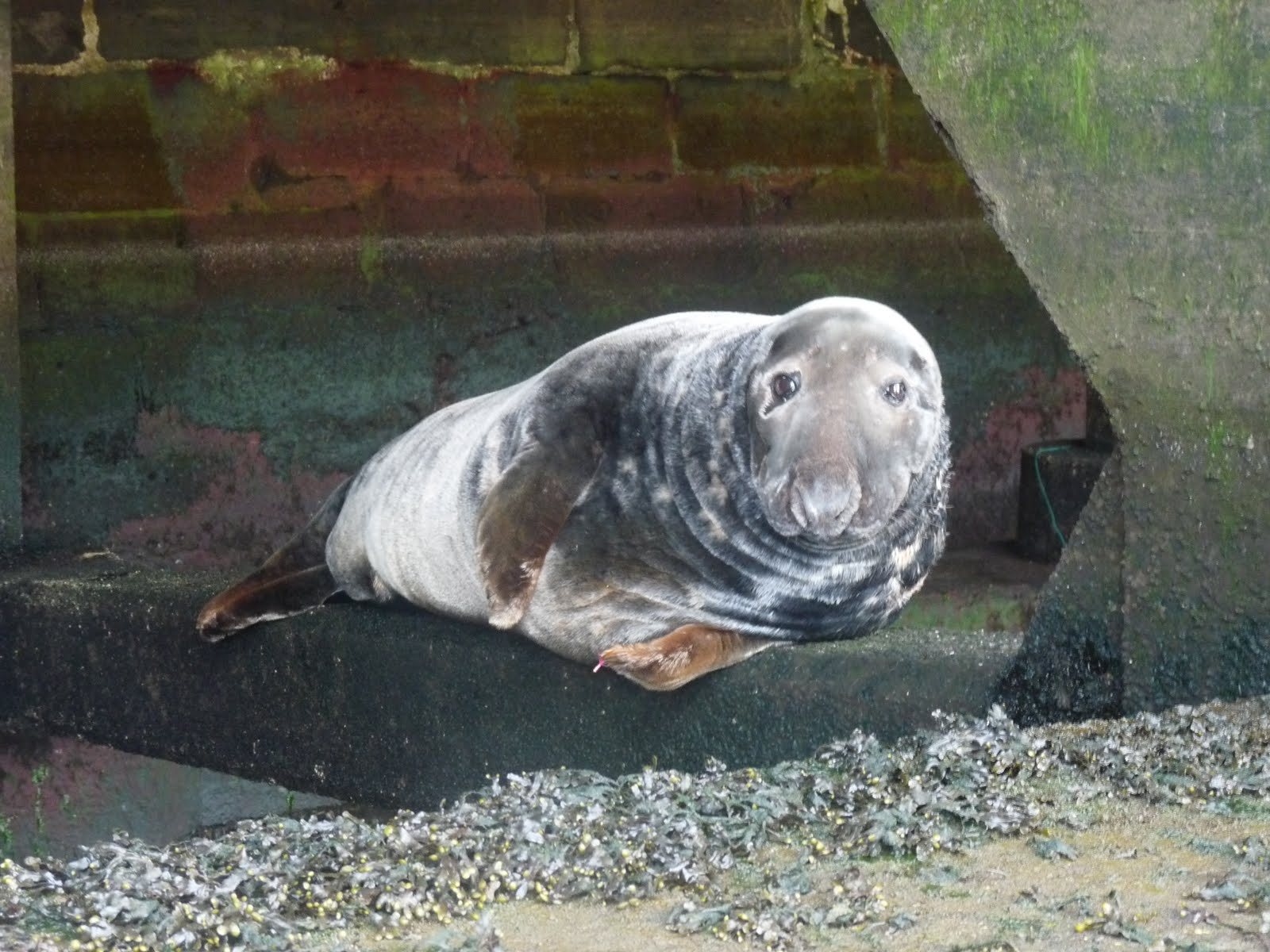
Stranded by the tide: a Stornoway harbour seal spotted early in the morning on one of the beams under the pier. She was a long way up from the waterline by this time and must have been sleeping there while the tide receded.

Oh, the beaches

On Barra we were quite lucky with the weather so we could climb Ben Heaval, the highest peak, paddle our inflatable canoe across the bay to Vatersay and collect whelks and mussels there. We also walked to possibly the most beautiful beach we've ever been to. We then tried our hand at a spot of hitchhiking around the island's 'ring road': the first car stopped. The driver, the coxswain of the Lifeboat, could only take us part of the way as he had to visit his parents so he directed us a pub in North Bay, where he would pick us up later and drive us back to Castlebay, which he duly did. It was a breezy day, but he told us that in the winter there were several days where it blew up to 150-odd miles per hour. Ouch.

Ben Heaval from Vatersay
On top of Ben Heaval
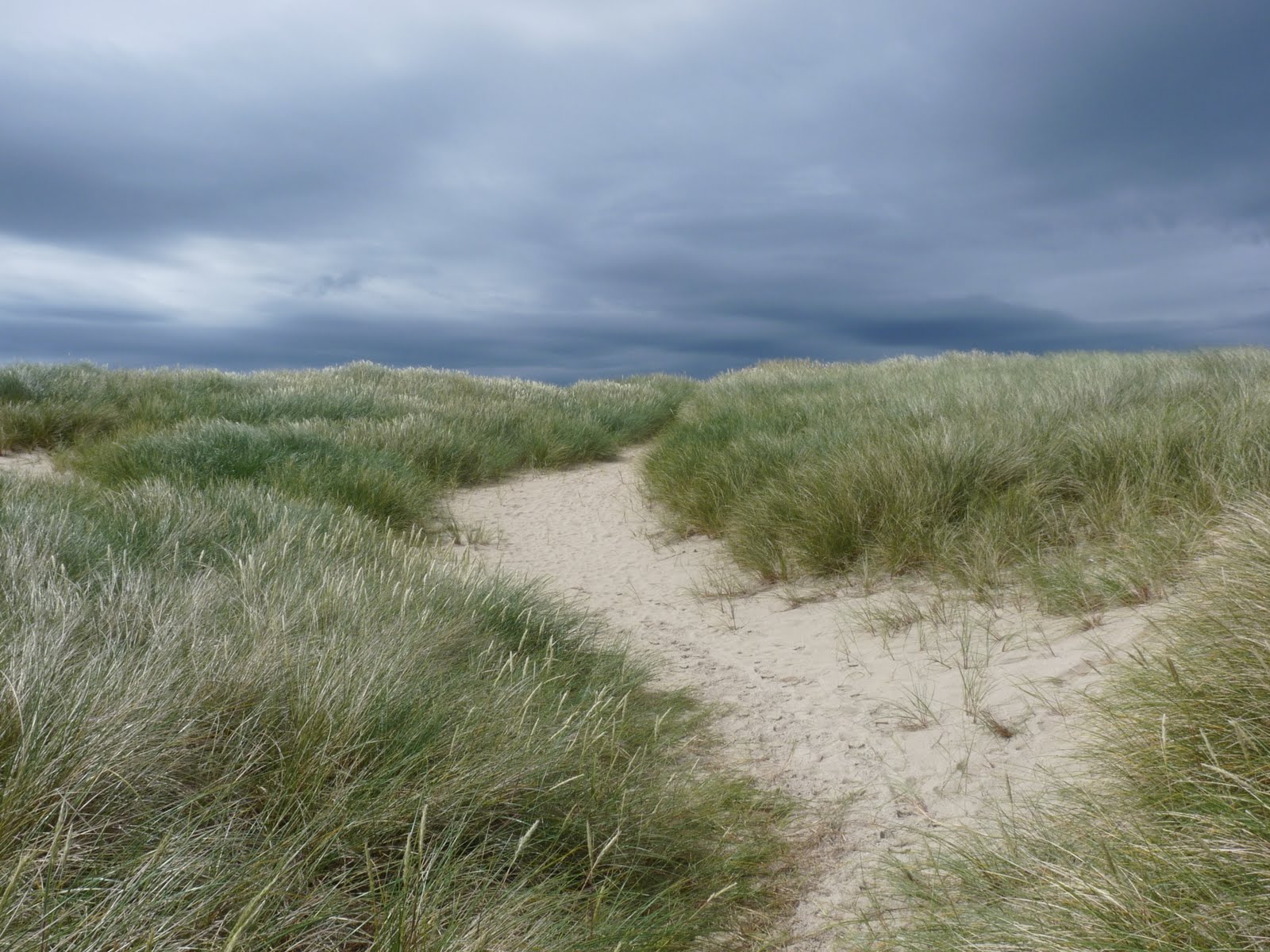
Dunes on the west coast of Barra
Our favourite beach
And the cows like it, too

To the Outer Hebrides

We left Canna in the company of Hyskeir, planning to make for Eriskay. However, the point of sail wasn't ideal so Paul and we said cheerio over the VHF, ourselves heading south to Barra, while he made for Uist. This was after an amazing basking shark bonanza on the north side of Canna. Dozens of the gentle giants were swimming all around us.

We absolutely loved Barra. The scenery is stunning with beautiful white sand beaches next to rugged mountains, the people are extremely friendly and helpful and there was a lot going on in Castlebay. We even went to the cinema there in the Screen Machine, a lorry that converts into an 80-seat cinema.

In Castlebay there are 12 visitors' moorings, which are a very reasonable £8 for up to a week's stay. The ones closest to the pier even have wifi internet access - luxury!

We were pleasantly surprised when another Trintella 29, Barrosa, arrived in Castlebay and enjoyed spending some time with her crew. Very interesting to compare boat notes.

Stunning setting of the visitors' moorings
Kisimul Castle at sunset
The ferry arrived every evening