Unusually calm conditions on a hot early summer's day encouraged us to anchor at the normally forbidding island of Inchmickery, an island in the Forth that is shaped like a battleship.
Inchmickery from afar, showing the battleship shape with the Forth Bridges in the background.
The first delight was a group of young seals basking under the watchful eye of a large and plump matron. The pups are nearing independence but are still quite small and have much of their golden fuzzy coat, only obvious when they're lying dry in the sun.
The island is a bird sanctuary, with different types of gull, eider and cormorants flying about. There is little evidence of human influence other than the decaying Second World War fortifications.
Fettler and Hannaine at anchor - a fairweather anchorage only.
The Oxcar lighthouse
Sunday, 6 June 2010
Sunday, 2 May 2010
Downwind to Dunbar (and back)
The season is getting off to a good early start.
Last Saturday was the first club sailing event - a well-attended cruise in company that took us the short hop across to Aberdour. 11 Corinthian boats rafted up in the very picturesque harbour on a gorgeous warm sunny day.
This weekend we elected to head for Dunbar, a pretty fishing port 30 miles out to the east. There was a race there on Saturday but we went on Friday, since the wind was favourable and forecast to switch to the opposite on Saturday.
It was a good choice. Friday afternoon was beautiful, with just enough westerly breeze to waft us along to Dunbar in a respectable 6 hours. Conditions were ideal for finally breaking out our spinnaker.
That's not to say that we hadn't ever encountered similar conditions, but we'd always been either too lazy or not under enough time pressure to do it. This time we had a stark deadline as access to the harbour is strictly tidal and there are no decent anchorages anywhere near by. Thanks to the spinnaker, we made it with about half an hour to spare.
Dunbar can be a bit tricky to get into, with a very narrow entrance and quite a few rocks strewn about it. Conditions were ideal on our approach, all calm and rocks clearly visible with the tide quite low. In strong easterly winds, the entrance is impossible and the harbour itself becomes very dodgy. Boats then have to move into the inner harbour which dries completely but is very secure. Anyway, we managed to nip in and tuck ourselves right under the castle wall.
Another first this weekend was drying out against the harbour wall. It's surprising that it took us this long, as nearly all the harbours in the area are drying, but it worked out without drama. I placed a large bucket on the shoreside deck and filled it with water to encourage her to lean the right way when touching down and looped a line from the mast to a strong railing on the shore for added security.
The vessel rested on the sandy bottom for about 2.5 hours around low water, an hour and a half before and only an hour after, interestingly. It was a fairly large tide at around 5 metres. At high water we could almost step ashore from the coachroof without a long climb up the ladder.
Last Saturday was the first club sailing event - a well-attended cruise in company that took us the short hop across to Aberdour. 11 Corinthian boats rafted up in the very picturesque harbour on a gorgeous warm sunny day.
This weekend we elected to head for Dunbar, a pretty fishing port 30 miles out to the east. There was a race there on Saturday but we went on Friday, since the wind was favourable and forecast to switch to the opposite on Saturday.
It was a good choice. Friday afternoon was beautiful, with just enough westerly breeze to waft us along to Dunbar in a respectable 6 hours. Conditions were ideal for finally breaking out our spinnaker.
That's not to say that we hadn't ever encountered similar conditions, but we'd always been either too lazy or not under enough time pressure to do it. This time we had a stark deadline as access to the harbour is strictly tidal and there are no decent anchorages anywhere near by. Thanks to the spinnaker, we made it with about half an hour to spare.
Dunbar can be a bit tricky to get into, with a very narrow entrance and quite a few rocks strewn about it. Conditions were ideal on our approach, all calm and rocks clearly visible with the tide quite low. In strong easterly winds, the entrance is impossible and the harbour itself becomes very dodgy. Boats then have to move into the inner harbour which dries completely but is very secure. Anyway, we managed to nip in and tuck ourselves right under the castle wall.
Another first this weekend was drying out against the harbour wall. It's surprising that it took us this long, as nearly all the harbours in the area are drying, but it worked out without drama. I placed a large bucket on the shoreside deck and filled it with water to encourage her to lean the right way when touching down and looped a line from the mast to a strong railing on the shore for added security.
The vessel rested on the sandy bottom for about 2.5 hours around low water, an hour and a half before and only an hour after, interestingly. It was a fairly large tide at around 5 metres. At high water we could almost step ashore from the coachroof without a long climb up the ladder.
The view out from the inner harbour
The castle wall is home to the country's 'largest seabird colony occupying a man-made structure'. There are a couple of thousand squawking kittywakes that nest here, crying their name for all to hear for about 16 hours of the day. Only during the hours of darkness do they fall silent.
We had a bit of a wander around Dunbar on Saturday morning while the tide was out, particularly enjoying the views around the inner harbour and from the clifftops. It really is a pretty town.
As forecast, the wind came around to the east on Saturday and all the fishing boats shifted into the inner harbour. The friendly harbour master mentioned to me that conditions could be getting unpleasant if the worst forecasts proved correct. In fact things stayed fairly mild, but even so an unpleasant surge was developing in the harbour and we decided to pull out and head back west, rather than remain uneasy about when or if things were going to get worse.
The wind was favourable for our run back, but it was mighty chilly and we were wrapped up in thermals, full oilskins and gloves, which was a contrast to the near t-shirt weather of the day before.
Sunday, 18 April 2010
A new season begins
The long cold Edinburgh winter has finally passed on and the smallcraft of Granton Harbour have once more been reintroduced to their native element.
The main boat improvement project we undertook this year was to make the windows watertight again, as most of them had developed slight but annoying leaks.
This involved firstly removing them and covering over the window openings with blanks of varnished (skip-raked) plywood, sealed on with silicone to keep everything dry over the winter.
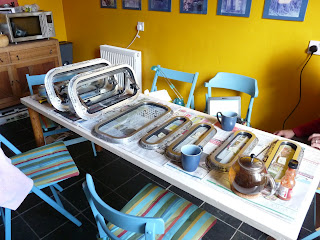
We then carefully packaged up all eight of them and shipped them off to the original manufacturers (Branchsound, in Essex) for a complete strip down and refurbishment. The boys at Branchsound made an excellent job of this, rebedding the glass into the aluminium frames and replacing parts such as hinges on the opening windows, all at reasonable cost.
After the windows were returned to us, I went round and cleaned off as much as possible of the old bedding compound and then carefully touched up any damaged areas on the anodised finish (using the Por15 paint system) to protect them from further corrosion. All of this took a surprising amount of time...
Lift in was quite early this year (3rd of April), so time was getting a bit tight when conditions were good enough to get on with re-installing the windows into the boat. We did make it, without a lot to spare, and wasn't it lovely to have plenty of natural light below decks again?
Here we are, removing the ply blanks and prepping the openings to recieve the nearly-good-as-new windows again:
They were bedded into the hull with Dow Corning 781 sealant. I haven't taken a photo yet with the windows back in, but anyway they look pretty much the same as they did before.
What else have we been up to...
Replaced the aft end of the exhaust outlet. There was a solid bronze swan neck, made up from apparently large ship pipe fittings, which led to a substantial (but unfortunately non-functioning) seacock before exiting the hull.
I had always been a little uneasy about that seacock not working, particularly on long offshore passages. There was one occasion in particular, when running up the Irish Sea before a gale, when I would have liked to be able to close it off to eliminate any possibility of large following seas forcing their way back through the exhaust into the engine.
My original intention was to replace just the seacock, without messing about too much with the rest of it, but the disassembly turned out to be a challenge (involving some very large spanners, a couple of hammers, one of the sheet winches and some line, a blowtorch, a hacksaw and the usual blood sweat and tears) so I decided in the end to overhaul the complete after end of the system.
The brief was to simplify, reduce weight and the need for maintenance. I replaced most of the bronze bits with highly flexible exhaust hose (giving the same overall rise in the swan neck) and the seacock with a very nice GRP non-return (check) valve.
Replaced the VHF aerial. Just before putting the mast back up. That was fun, particularly when the old cable snapped as I was pulling it out. That meant taking off the cap and foot of the mast and scrounging up a length of fence wire to fish the new cable through. I have a Dri-plug still to be fitted at the deck, which will make life a lot easier the next time the mast is taken down.
Replaced the lifelines. Yeah.
Aside from that, it was just the usual painting, antifouling and general maintenance.
Ongoing projects:
Fitting an extra bilge pump, to allow pumping from the cockpit without having to open the cockpit locker where the existing pump is sited.
Doing away with gas on board. I have purchased a pair (one as a complete spare) of beautiful new-old, British made paraffin stoves, one to be mounted up in a similar manner to the Atom stove. There are just too many stories out there of gas explosions aboard small boats. Besides, it seems to be getting more and more difficult to have cylinders filled abroad, to the extent that in some places one is forced to buy an entire new cylinder and regulator just to get some gas.
The list goes on.
Maybe, just maybe, we'll get out for our first sail of the season this afternoon.
Update:
We did go for a sail and it was delightful. The sun shone, the breeze was light, the seals were basking and there was not a plane in sight.
And here's one especially for Fran. Fettler has her eyes back! We finally managed to get our hands on a drop of white antifouling paint:
Update:
We did go for a sail and it was delightful. The sun shone, the breeze was light, the seals were basking and there was not a plane in sight.
And here's one especially for Fran. Fettler has her eyes back! We finally managed to get our hands on a drop of white antifouling paint:
Wednesday, 11 November 2009
On the hard again
We're just starting on our winter maintenance programme. The main job for this winter is the servicing of the port lights, which were letting in a little water. They'll be sent to the original manufacturer (Branchsound, down in Essex) for refurbishment. We're also planning to replace the lifelines.
Two of the port lights are out already (after a bit of a struggle to free them from the sealant with which they were bedded in), and varnished plywood cutouts carefully sealed in their place. This arrangement should keep things tight until spring, when the windaes can go back in. Hopefully, we'll get the rest of them out this weekend.
Saturday, 19 September 2009
Inchcolm
Our programme of late season sailing continues with a visit to the monkish island of Inchcolm. We had hoped to get a little further afield this weekend, but the weather hasn't been quite right for it, so we decided instead to do a bit of local pottering.
Inchcolm has been in our sights for some time so we decided yesterday to make the short hop across there and anchor up for the night.
The island, with the remains of its ancient abbey and more recent wartime fortifications is well worth a visit of several hours, particularly if you have the good fortune of arriving just as the last tourist boat of the day pulls out.

Apart from a mercifully brief visit by a disco boat, the peace of a thousand years' monastic contemplation pervaded the island and anchorage overnight and in the morning we were awakened by the sound of a seal splashing round the boat. A gem of a mini-cruise.
Sunday, 13 September 2009
Fidra wildlife
Had to include a few extra shots of some of the creatures that make this wee island their home.
Fidra weekend
After a rather damp and windy August, a weekend of great weather has finally come to the residents of central Scotland. We seized the opportunity to take off on an overnighter to the island of Fidra (we had intended to go a bit further, to Dunbar, but the wind packed in..). It was a very gentle sail out there in the warm autumn sun, a peaceful night and quite a thrilling beat back upriver into a stiff breeze the following morning.
Subscribe to:
Posts (Atom)